|
T
E
A
M
C
A
P
S
U
L
E
S
|
|
W
E S T D I V I S I O N
|
E
A S T D I V I S I O N
|
|
 St.
Louis Maroons
St.
Louis Maroons
Tim Smith
83-71,
.539 -- 1st
|
Player of the Year
Gene
Woodling
(.319-19-93, .896 OPS)
|
 Brooklyn
Superbas
Brooklyn
Superbas
Glen Reed
100-54,
.649 -- 1st
|
Player
of the Year
Gene
Conley
(26-3, 2.40, 222 K)
|
|
Another
Late Surge Wins the West
by
Timothy J. Smith
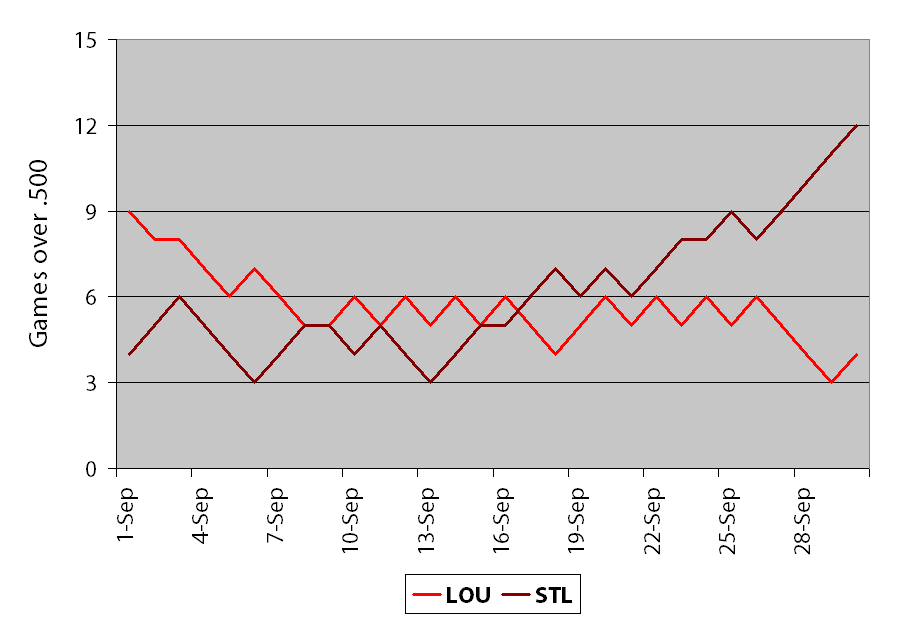
The St. Louis Maroons used another
September surge to overtake Louisville
and win the first West Division
title. Louisville led by 5.5
games after the first half, as the
Maroons stumbled to 36-38 start.
But the offense picked up in the
second half, thanks to the addition of
All-Star Gene Woodling and the
emergence of 'Stan the Man' from a
season-long slump.
Musial was the object of
major concern for most of the
season. The powerhouse of the
St. Louis lineup had just 11 HR and 45
RBI through July 31, and a .258
average. But he slowly returned
to form in August and finished strong,
batting .394-5-19 in September,
leading the Maroons to a 17-10
finish. The teams top two
hitters were both new additions.
Woodling led the team with a .319
average and 93 RBIs (split roughly
evenly between St. Louis and his
former team Brooklyn), and 36-year old
outfielder Willard Marshall, a Reentry
pick, hit .307-16-81 with a career
high .844 OPS. Dick Kokos
(.274-27-78) continued to develop into
a heart-of-the-order hitter, and
second baseman Hector Lopez
(.275-20-66)won an All-Star
nomination.
The key figure in the
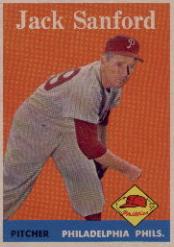
pennant surge was rookie pitcher Jack
Sanford (8-1, 3.09), who debuted on
July 20 and won all eight games he
started, including five in September
and two shutouts in the final two
weeks. Ace Billy Pierce (19-9,
2.79) narrowly missed his fourth
20-win season, Spec Shea (16-13, 3.35)
won a career high 16 games, and
36-year-old Larry Jansen won 16 games
as the #3 starter. The club
lacked a regular closer, with Roy
Face, Ray Moore, Jim Brosnan filling
the role, in turn. Brosnan had
eight saves in September.
The Maroons lost the
inaugural UL World Series in five
games to Brooklyn, perpetuating the
club's reputation as the league's
perennial bridesmaid. The
Maroons have finished second in five
of the last six seasons.
"Given our slow start, we were
happy to win the division and get a
shot at the title," GM Timothy J.
Smith said. "This was not
our best team, but we added some new
players and we are looking forward to
making another run at it in
1958."
|
Clearing
Hurdles with New Stars
by
Glen Reed
Anyone who's ever played a baseball
simulation game with me
before (and that's about half the
league) knows that my only goal is to
make it to the postseason; what
happens after that is too hard to
predict
or control for in a short
series. And anyone who's played
with me in this
league knows that my goal every season
is to finish ahead of the Mons, the
unquestioned UL dynasty team. So
by those standards, 1957 has been a
great
success because we were able to clear
those big hurdles despite breaking up
the core of the team that carried us
to the flag just two years ago.
Poor
salary structure under the league's
prevailing financial rules meant that
we had to ship out long-time Superba
greats Gil Hodges (who had his 2nd
best year ever after relocating to the
Windy City) and Gene Woodling (our
prototype ballplayer -- great D,
average, and OBP). The totality
of those moves lopped upwards of $20MM
off the top line, and thrust guys like
Frank Thomas and Sandy Amoros into
starring roles. And certainly
the maturation of Granny Hamner and
Gene Conley -- players for whom
stardom had been long anticipated, but
much delayed -- helped offset the loss
of old-time, big-name 'Bas.
Speaking of Gene
Woodling, we'll get to see him again
up close and personal in the World
Series. that's a fate we'd hoped to
avoid, but somehow knew to be
inevitable. While pundits look
at our record for '57 and give us a
big edge over Woodling's Maroons, our
assessment is a little
different. St.
Louis was our nemesis all year,
winning two-thirds of our head-to-head
matchups. No team, not even
Washington, gave us so hard a
time. And it's
not hard to see why -- befitting our
cavernous stadium, our club is devoid
of
power and built on the hit-and-run
concept. For that strategy to
work, we
have to put together two and even
three hits an inning to score a single
run; meanwhile, St. Louis is the
hardest team in the league to hit
against. What's more, the
Midwesterners come at you almost
exclusively from the left
side of the plate; meanwhile, our
staff leans heavily to the
right. Southpaw reliever Chet
Nichols was brought in to address that
very issue, but has so far been
underwhelming. Finally, our edge
over the rest of the league rests
heavily on the quantity and quality of
our hurlers. But St. Louis is
right there with us; not even
Washington has as many pitchers of
quality. Add it all up, and
we'll be gald to simply stretch the
series as long as possible, hoping to
get a break here or there to turn the
tide in our favor, while also boosting
the bottom line by getting paying
customers through the turnstiles.
|
|
 Louisville
Colonels
Louisville
Colonels
Mark Allen
79-75,
.513 4 2nd
|
Player
of the Year
Herm
Wehmeier
(23-15, 3.65, 165 K)
|
 Washington
Monuments
Washington
Monuments
Jay Kaplan
95-59,
.617 5 2nd
|
Player of the Year
Carl
Erskine
(27-6, 3.08, 140 K)
|
One
Step Closer
by
Mark Allen
While not their best year record
wise, 1957 was the best finish ever
by the Colonels. They led the
West Division most of the season,
before faltering in September to
finish four back of the cheating
Maroons. :)
The team built on speed
(284 SB -- 74 more than 2nd place St
Louis) also showed some power as Ed
Bailey and Henry Aaron led the way
with 66 HR between them.
The Hammer also reached a milestone,
becoming the charter member of the
30/30 club. The ageless Elmer
Valo proved to be a valuable
sub/sometimes starter/PH as he hit
.358 as a pinch hitter. Nellie
Fox and Al Kaline were the main
speedsters with 50+ swipes each.
The Colonels have tough
decision to make between Jackie
Jensen and Wally Post in the
outfield as the other two spots are
wrapped up by Kaline and Aaron.
Both Wally and Jackie expressed
their displeasure over sharing time,
creating distractions in the
clubhouse. If Jensen gets the
nod over Post next year, the
Colonels have the potential to have
three players with 50+ stolen bases.
A
big disappointment was 3B Andy Carey
who hit only 222 while sharing the
hot corner with Felix Mantilla, who
as a rookie played admirably.
The pitching also came
through even though Antonelli
dropped way off from his Cy Young
effort last season, with only 206
strikeouts, 166 fewer than last
year. Herm Wehmeier had a very
good year going 23-15. Porterfield
also was not what was expected and
the Colonels still lack solid #3 and
#4 starters.
|
Kaplan's
Swan Song
by
Timothy J. Smith
Washington stormed out of the gate
with the best first half in league
history (52-20), and carried a 6.5
game lead over Brooklyn into the
Midsummer Break. But five
straight losses to the Superbas in
early July signaled a second half
collapse. The Mons were 43-39
after July 1, while Brooklyn surged to
the first East Division title with a
52-25 finish.
The Monuments' 95-59
record was second best in the league,
and extended GM Jay Kaplan's streak of
90+ win seasons to six years.
However, the second half slump
indicates that the dynasty may be in
its dying days.
The club's 3.88 ERA was
the highest since 1951, as the
rotation began to show the effects of
age and wear-and-tear. Carl
Erskine, Cy Young runner-up last year,
had another dominant season, anchoring
the staff with a 27-6 record and 3.08
ERA. Oisk led the league in wins
and was third in earned run
average. The righthander has won
73 games in the last three seasons, a
UL record.
Stu Miller (20-11, 3.53)
bounced back from his back problems to
pitch his first full season since
1954, though he wasn't nearly as
dominant as he was before the ruptured
disk. Dave Koslo began to show
his 37 years with a 3.91 ERA, his
highest since 1953, but still managed
an 18-10 record. Warren Hacker
(12-17, 4.90) struggled mightily,
falling far short of his phenomenal
1956, in which he went 23-9. Ted
Abernathy posted 40 saves for the
second year running.
Offensively, the Mons
posted their lowest run total in four
years. After his best season
since returning from Korea last year,
Duke Snider had the worst year of his
career in 1957, batting an anemic .212
with a .389 slugging percentage and
just 58 RBIs. Hank Thompson's
power numbers were down as well.
The 30-year-old second baseman hit
just six home runs in 101 games, and
was demoted to a platoon role in the
second half.
But there were some solid
performances. Center fielder
Willie Mays posted his third straight
season with at least 30 home runs, 90
RBI, and 100 runs, and joined Hank
Aaron in the 30/30 club on Sept.
19. The "Say Hey Kid', just
25, ranked third in slugging and OPS
and won his fourth Gold Glove (1951,
1953, 1955, and 1957... that's
odd). "Big Klu" Ted
Kluszewski took over first base full
time, and responded by posting a .285
average with 17 HR and 84 RBI.
Catcher Joe Ginsberg (.354-10-57)
figured in the batting chase
momentarily, before finishing slightly
below the eligibility threshold.
Outfielder Wally Westlake, 35, drove
in 64 runs and hit .318, and shortstop
Dick Groat won his second Gold Glove,
while driving in 52 runs.
Jay Kaplan, one of the
League's founding owners, stepped down
as Monuments GM after the
season. Kaplan built a dynasty
in Washington on par with the greatest
in baseball history, winning three
straight championships in 1952-54 and
a fourth in 1956, and leading his club
to six straight seasons with at least
90 wins. His four championships
and .611 winning percentage (659-419)
are unlikely to be surpassed anytime
soon.
|
|
 Chicago
Colts
Chicago
Colts
Lance Mueller
71-83,
.461 12 3rd(t)
|
Player
of the Year
Gus
Zernial
(.266-46-108, .915 OPS)
|
 Detroit
Sound
Detroit
Sound
Sean Holloway
71-83,
.474 27 3rd
|
Player
of the Year
Pedro
Ramos
(23-12, 3.29, 154 K)
|
|
Rumblin'
. . . Bumblin’ . . .
Grumblin’
by
Lance Mueller
What’s
there to say…horrible start, nice
midseason turnaround, collapse at the
end…sound familiar? The Colts
continual, habitual, chronic (you get
the picture) tendency of looking like
contenders on paper and performing
like pretenders on the field has left
GM Lance Mueller wondering what to
do. The acquisition of Gil
Hodges seemed like a move that would
put the Colts over the top, instead
they finished worse than before they
acquired him. There were
highlights: Gus Zernial’s home run
record, Hodges and Zernial’s
three-dinger games, another great year
from Ernie Banks, a solid first outing
from rookie Jim Landis, and the
emergence of veteran Bobby Adams. But
the lowlights far outweighed the
positives: mediocre pitching from a
roster full of good arms, a 3-14
start, an overblown budget with
underachieving results, dropping fan
interest despite a new train stop, $18
million in lost revenues, and of
course Whitey broke…again.
The
’57 season was filled with few
surprises and many minor
disappointments but the lasting
feeling was one of pent up frustration
reaching a boiling point. The Colts
have too much talent too be a .500 or
below team. There are many
reasons why this team continues to put
up mediocre results but one key factor
is Wrigley Field. The “Friendly
Confines” are anything but friendly
to pitchers…and the baseballs that
are so unceremoniously deposited on
Sheffield
and Waveland Avenues. Wrigley is
a hitter’s paradise and the Colts
could field a bullpen of starters who
throw 100% groundballs and still give
up more dingers than just about any
other staff. All of this has led
the Colts front office to start talks
with league officials about the rules
and ramifications of “relocating”
a team within the same city.
Comiskey
Park
’s more pitcher friendly makeup and
it’s 50,000+ seating capacity make
it an attractive alternative to
Wrigley. Alas, a move is still
very much up in the air, the only
thing for certain is the Colts will
put ’57 behind them and focus on
having a strong draft in an effort to
compete for the WestDivision
title…where the home games of that
battle will occur is still a question
waiting for an answer.
|
A
Giant Sucking Sound No More . . .
by
Sean Holloway
When Sean Holloway took over the GM
duties back in September 1955, no one,
not even Holloway himself had an idea
of how bad things were in
Detroit
. The Sound, under former owner
Brad McNeely, made little to no sound
at all – except for the footsteps of
fans stampeding for the exits or the
cacophony of groans, jeers and
invectives of the several hundred
masochistic fans that remained.
After
1954, few in
Detroit
thought it could get worse, but the
combination of overpaid fat boys on
the field and McNeely’s blunderous
moves in the front office resulted in
Detroit
not only finishing dead last two years
in a row, but also having a shaky
balance sheet and financial
difficulties to boot. Then, when
word was leaked that ESPN notified
McNeely about including the 1955 Sound
(55-99) in its “Worst Ever” list,
fan outrage in the
Motor
City
hit an historic high. McNeely
panicked after discovering the
City’s motto (
Detroit
– where the weak are killed and
eaten) and left town in a hurry.
When angry fans reached the Sound’s
front office, they found that McNeely
made no attempt to shred damning
evidence against him (such as Clem
Labine’s and Ferris Fain’s
contracts, or for that matter, Labine
and Fain themselves), lending further
credence to the theory that the team
was nothing but a tax write-off.
Native
Detroiter Holloway stepped in gamely,
but even he was unprepared for the
mess known as the Sound.
“I’ve unfortunately often had to
watch the Lions attempt to play
football, lived through the ‘Dead
Wings’ of the late 1970s-early 80s,
and I went to Michigan State.
The magnitude of the sucking coming
from the Sound, though, stunned even
me. And it wasn’t just the
poor play that ticked Holloway off:
“when you have pseudo-street punk
Eminem hanging out with his ‘crew’
in the dugout, good things won’t
happen. It soon became clear to
me that things around the clubhouse
had to change drastically.”
And
change they did. High-priced
under-performing veterans grumbled as
Holloway instituted mandatory
practices and work-out regimes, as
well as requiring them to actually sit
through games to the end, instead of
leaving early to get a head start on
exiting ballpark traffic. The
final straw was when the GM ordered
that the team would travel together
and stay in the same hotels on the
road. This infuriated most of
the vets, especially SP Vic Raschi,
who stated “I did my time and paid
my dues……as a veteran I deserve a
$3.2 million salary per year, as well
as all the perks that go along with
it”. Holloway, upon hearing
Raschi’s scathing condemnation of
the new rules, retorted “he
certainly did do his time – on the
bench and in the minors” before
breaking into his best vacuum
cleaner-imitation of a sucking sound
and following Raschi around the locker
room – a clear signal that Raschi
was most likely done in Detroit.
Soon
after that, the slash-and-burn
started, with Robin Roberts and Raschi
heading to
Chicago
and Bob Rush traded for a draft pick.
Other pathetic vets woke up to find
their contracts weren’t renewed, and
Holloway instituted a number of
changes aimed at injecting new life
into the floundering franchise, be it
through rookies or hard-charging
veterans. By 1957, catcher Toby
Atwell found himself batting second
and became a .300 hitter and a Gold
Glove winner, while Dusty Rhodes saw
new life in the outfield on the way to
batting .330. The infield was
revamped with the additions of 2B
Bobby Richardson, SS Tony Kubek (1957
Gold Glove winner), and 3B Frank
Malzone. Joe Cunningham moved
from his familiar position at 1B to RF
and finished with a .315 average.
Pedro Ramos and Johnny Podres became
the anchors of the starting rotation,
while Sandy Koufax, Bob Grim, and
Gordon Jones were the new go-to guys
in the pen. With Gene Cimoli,
Jim Greengrass, Joey Jay, and Lindy
McDaniel in the minors and some luck
with rookie picks in next year’s
draft, DET is looking to further
improve.
“We
ain’t done anything to earn the
respect of the league yet” chimed
Holloway at a recent press conference
immediately after the season ended
with the Sound finishing 73-81 and
third in the East Division – a vast
improvement over the 1955 debacle.
“We have, though, come a long way,
and I’m fairly sanguine about the
future. No one, though, should
expect this team to become the new
Washington
Monuments
or Brooklyn Superbas of UL.
We’ll work on the basics and always
play hard, and, with a little luck, we
may be in position to compete with the
elite teams of the league within a few
years.”
After
this brief synopsis of his two-year
tenure, Holloway then dropped a
bombshell on the gathered reporters.
The Sound will be no more……at
least not in name. In an effort
to distance the organization from its
horrendous past, the team will become
the Detroit Griffins starting next
season. “It was clear to me
that something had to be done”
stated Holloway. “If you
looked up the word ‘suck’ in the
dictionary, it had a picture of the
Sound’s logo after the definition.
This will just not do. Pride is
the key to playing well. And
besides, what the hell kind of a name
is the ‘Sound’ anyway? Was
this guy on dope or what?”
Thus,
in 1958,
Detroit
will start the season with many new
faces, a new attitude, a new
name/logo, and even maybe a bit of
hopefulness. Walking back to his
slammin’ 1999 Chevy Prism LSI in the
Griffins’ parking lot, Holloway was
asked if this new logo will have
immediate and tangible effects for
Detroit
. “No” he responded, “but
it’s a start.”
|
|
 San
Francisco Spiders
San
Francisco Spiders
John Nellis
71-83,
.461 12 3rd(t)
|
Player
of the Year
Rocky
Colavito
(.261-36-107, .863 OPS)
|
 Boston
Beacons
Boston
Beacons
Charlie Qualls
66-88,
.429 34 4th(t)
|
Player
of the Year
Roger
Maris
(.288-23-89, .889 OPS)
|
|
More
Pessimism
by
John Nellis
The
past season was once again a
disappointment for S.F. . The Pitching
staff really needs an overhaul, and
the free agents that were brought in
have really been a bust. The team has
never recovered from the poor initial
expansion draft. The offense is
starting to come along with OF Rocky
Colavito leading the way. The team
still needs another bat or two to
generate more offense. The fans
once again showed their displeasure
and we had another down year in
attendance and popularity. We will
have to work hard to bring them back,
unfortunately we have a long, long,
way to go.
Not
So Bad
by
Timothy J. Smith
The
Spiders were actually in the West
Division race for much of the year,
and were only five games out as late
as July 31. However, they fell
out of the race with a 26-32 finish
while St. Louis and Louisville pulled
ahead of the pack. The
difference was clearly pitching.
The Spiders just don't have the
top-of-the-rotation quality to
compete. Hal Brown (12-16,
4.98), Bobby Shantz (13-11, 4.30), and
Tom Sturdivant (12-13, 4.60) were
workhorses, compiling over 700 innings
between them, but all three are bottom
of the rotation guys, and alas, the
bright star Sturdivant was not
renewed.
The club ranked second in
batting, and third in home runs and
runs scored. RF Rocky Colavito
built on his strong rookie year,
batting .261-36-107 to lead the club
in home runs, RBIs, and
slugging. CF Jim Lemon also had
a breakout year (.287-16-93) and Vic
Wertz (.261-20-78) hit 20 jacks for
the seventh straight season. Wes
Covington (.290-13-41 in 260 PA) and
Sam Mele (.310-10-32 in 304 PA) were
productive part-time players, and 2B
Red Schoendienst reversed a long-term
decline to post career highs in
batting (.327) and OBP (.364) and his
highest OPS (.821) since 1952.
|
The
Best of the Worst
by
Charlie Qualls
Yes,
another downer season, but a far cry
from 1956’s 101 loss debacle.
Although having a strangle hold on 8th
place going into the last week, we
found our way back into the wank tank,
ending in a three-feller-in-the-cellar
tie with L.A. and New York. But
thanks to a winning record against the
other two lasties, we find
ourselves… in 8th place. And
unlike like last season, there were
some pleasant surprises.
Yummers:
Harvey Kuenn stepped up his slugging
production while not missing a step in
AVG or OBP. Hank Aguirre turned
in the best performance of the regular
starters, matching his ERA (3.53) with
his childhood hero Stu Miller’s,
both narrowly landing in the top
ten. Lou Brissie showed flashes
of dominance in a late season
promotion and boasted the rotation’s
only winning record.
Don Liddle was used far less than in
previous seasons, but pitched more
effectively, nabbing the team’s
lowest ERA. Roger Maris had a
career year, bringing home the club's
first ROTY Award.
Bummers:
Bruce Edwards is showing signs that he
is slowing. Jumbo Gilliam knows
not where he is going. Mantle
(when not hurt) is simply blowing.
Jackson and Kiely? Hopefully
still growing.
Coan-sistency
When Gil Coan was brought on board, he
was told “Just do what you’ve been
doing.” Apparently he took it
to heart. In seven seasons, Coan
has never had what you might call a
“breakout” year, but he’s never
had an "off" year either.
In fact, Gil’s numbers year-to-year
have been remarkably similar.
|
|
 Los
Angeles Outlaws
Los
Angeles Outlaws
Chris McCreight
66-88,
.429 17 5th
|
Player
of the Year
Frank
Robinson
(.290-26-88, .889 OPS)
|
 New
York Gothams
New
York Gothams
Shawn Martin
66-88,
.429 34 4th(t)
|
Player
of the Year
Bob
Friend
(19-17, 3.81, 154 K, 5 SHO)
|
|
Expansion,
Contraction
by
Chris McCreight
The Outlaws started off the season
thinking they had a chance--that they
were better than an expansion
team. Sadly,
this was not the case. Winning
11 games less than they did in their
first year and 10 games less than the
previous year, they finished in
dead last. Off-season moves to
bring in pitching completely failed.
In fact there were few bright spots.
Here
are a few of the thing LA can look
back fondly on:
1957
#1 pick Jim Bunning held his own as a
starter in the majors. Only nine
wins and a near 5 ERA might not seem
that great until you consider he
went straight to the majors after
being drafted.
Roy
Campanella, nearing the end of his
career, still put up good numbers
nearly hitting .300 with just a slight
drop off in power.
1B
Dale Long won another Gold Glove while
hitting .311. The question remains,
though. Will he be on the team this
season?
Only
22 years old, Frank Robinson is
starting to show why he is going to
dominate this league for a long time.
Closer
Ray Narleski was the only only bright
spot in the bullpen, saving 30 games,
nearly half of LA's wins.
What will happen in 1958? A
change of scenery might help.
[Arroyo Seco Stadium opens this
spring.] A healthy Roberto
Clemente and more maturity out of some
of the younger players might make the
Outlaws the surprise of the season.
|
High
Hopes
by
Shawn Martin
Hopes
were high for the New York Gothams
heading into 1957. New GM Shawn
Martin stated that “this team has
only one objective: to play in the
World Series.” Unfortunately
for Martin and the Gothams, 1957 was
not their year.
1957
would not be kind for the Gothams, as
they finished a disappointing 66-88,
tied for last in the East Division.
Jackie Robinson went from acting
manager to bench player, only getting
85 AB, hitting .235 with 7 doubles.
STARS:
Jim
Busby – Busby had his third
consecutive successful season, hitting
.311, while slugging 12 HR and
knocking in 62 RBI. The 30-yr
old centerfielder looks to have
another strong season in 1958.
Irv
Noren – Hit .286/.363/.476 with 18
HR and 71 RBI. The six-year
veteran maintained his .300+ career
batting average.
Wally Moon – The 27 year old first
baseman hit a respectable .304 in his
third full season in the UL. His
power numbers were down from 1956 (17
HR to 7), but he improved his patience
at the plate limiting his strikeouts
to just 39.
Ted
Lepcio – Lepcio spent the majority
of 1957starting at second base, where
Jackie Robinson played for so many
years. All he did was win the
Gold Glove Award for defense, while
batting .253 with 50 RBI.
Bubba
Church – 32 year old Church was the
Gothams’ most reliable starter,
going 19-17 with a 3.81 ERA in an
amazing 335 innings. Certainly the
workhorse of the pitching staff, he
also had 17 complete games, his third
straight 13+ CG season.
Bob
Friend – Friend had a nice
improvement for New York, coming into
his own with a 14-9 record and 3.31
ERA. He had some shoulder issues
during the season that hampered his
season, but he did throw 195 innings,
and traded his high K totals for a
more balanced WHIP.
FLOPS:
Bob
Hooper – The 34 year old closer
struggled through the summer months
giving up almost a run per inning in
June and July. He finished with
33 saves and a 4.35 ERA, but the swoon
he experienced in June crippled the
Gothams’ ship.
Art Ditmar – Ditmar was supposed to
improve on his stellar 1956 season
where he split the season as a starter
and a reliever. The Gothams gave him a
chance to start, but he went 10-16
with a robust 5.03 ERA in 236 IP.
His career in New York seems to be out
the door.
Larry Doby – When you lead your team
in home runs, you’re supposed to
strike fear in opposing pitchers.
Doby didn’t do that in 1957.
He did hit 19 homers, but only hit
.266 in his limited duty role due to a
nagging hamstring injury.
Al Rosen – The 33 year old Rosen
only hit .227 while striking out 106
times, a good number of which occurred
with runners on base.
Don Buddin – The young shortstop
sent most of the season up with the
big club, while not producing anything
resembling decent numbers. He
hit .249 in 98 games, bopping 5 homers
out of the park, and knocking 19 runs
home.
OUTLOOK:
The
future does not look good for the
Gothams in 1958. Jackie Robinson
refused a lucrative retirement package
in the offseason, and his ridiculous
$12.45 million contract stays on the
books. The Gothams’ attendance
was down again this year, causing
rumors concerning Shawn Martin’s job
security with the franchise.
|
|
|
|
|
|
Payroll
Cap Targets League Deficits
Attendance
Down, Budget Crunches Ahead
 NEW
YORK (Oct. 1) -- For the fourth time in five seasons the United
League lost money in 1957, posting a record shortfall of $103
million, up from last year's $82 deficit. League officials
cited declining attendance as the primary culprit. Average
attendance per game was down 11.4% this season, from 21,700 to
19,200. More than half of the attendance decrease is
attributable to the two New York franchises, a fact which worries
league officials who considered the Big Apple a baseball mecca.
The New York Gothams attracted 40% fewer patrons than last season,
dipping from 1.96 million to 1.18 million. Brooklyn, Chicago,
and Washington all had turnstile shortfalls of 300,000+ compared to
last season. The only teams to post increases were San
Francisco, which fielded a surprisingly strong team, and Louisville,
which packed 19,000-seat Parkway Field in more than two-thirds of
its home dates. NEW
YORK (Oct. 1) -- For the fourth time in five seasons the United
League lost money in 1957, posting a record shortfall of $103
million, up from last year's $82 deficit. League officials
cited declining attendance as the primary culprit. Average
attendance per game was down 11.4% this season, from 21,700 to
19,200. More than half of the attendance decrease is
attributable to the two New York franchises, a fact which worries
league officials who considered the Big Apple a baseball mecca.
The New York Gothams attracted 40% fewer patrons than last season,
dipping from 1.96 million to 1.18 million. Brooklyn, Chicago,
and Washington all had turnstile shortfalls of 300,000+ compared to
last season. The only teams to post increases were San
Francisco, which fielded a surprisingly strong team, and Louisville,
which packed 19,000-seat Parkway Field in more than two-thirds of
its home dates.
The problem a year ago was vastly increased payrolls as
a result of the 'superstar renewal' year. The five-year
contracts penned in 1951 all came due last year, prompting many
clubs to overspend in order to keep their marquee players. The
league's total wage bill skyrocketed from $514 million in 1955 to
$617 million last year, a 20 percent increase. This year,
payrolls remained fairly constant, edging up less than one
percent. Only two of ten clubs turned a profit in 1957 --
Boston and Detroit, the clubs with the smallest payrolls.
League president Timothy J. Smith commended owners Charlie Qualls
and Sean Holloway for their 'fiscal sanity', citing the new payroll
limits as a way to reign in costs. "It means that clubs
no longer have the luxury of throwing wads of cash at marginal
players, or at least they do so at their own peril."
Under the new cap scheme, each team's payroll is tied to its own
revenue potential. He added that divisional play and
particularly the revival of the World Series, would be major
revenue-producers, both in terms of fan interest and in the new
phenomenon of television broadcasts of baseball games. The
league just negotiated a new national television contract that gives
each club $3 million more per year through 1961.
"We are in a transitional phase right now,"
Smith elaborated. "We are still digesting expansion in
some ways, and the full effect of the new payroll caps won't be felt
until after two or three cycles of contracts. But I fully
expect club payrolls to more closely match reality very
soon." The belt-tightening will begin sooner rather than
later for several clubs. Los Angeles, New York, and Washington
are already over their cap limits, and will have to pass the Reentry
draft unless they can dump payroll, an unlikely scenario since most
clubs aren't much better off financially (the average club lost over
$10 million this year). Not surprisingly, Detroit and Boston
have the most cap space ($20.1 million and $14.8 million,
respectively) heading into the Reentry draft.
|
|
Granny
Hamner, BRO
|
.356
|
|
Minnie
Minoso, BRO
|
.353
|
|
Richie
Ashburn, BRO
|
.351
|
|
Sandy
Amoros, BRO
|
.342
|
|
Gene
Woodling, STL
|
.319
|
|
Hobie
Landrith, BRO
|
.314
|
|
Willie
Mays, WAS
|
.312
|
|
Jim
Busby, NYG
|
.311
|
|
Dale
Long, LA
|
.311
|
|
Al
Kaline, LOU
|
.308
|
|
|
|
|
|
Gus
Zernial, BOS
|
46
|
|
Ralph
Kiner, DET
|
41
|
|
Rocky
Colavito, SF
|
36
|
|
Hank
Aaron, LOU
|
35
|
|
Gil
Hodges, CHI
|
34
|
|
Willie
Mays, WAS
|
33
|
|
Ed
Bailey, LOU
|
31
|
|
Ernie
Banks, CHI
|
31
|
|
Dick
Kokos, STL
|
27
|
|
Eddie
Mathews, BOS
|
26
|
|
*Frank
Robinson, LA
|
26
|
|
|
Ralph
Kiner, DET
|
130
|
|
Granny
Hamner, BRO
|
109
|
|
Gus
Zernial, CHI
|
108
|
|
Rocky
Colavito, SF
|
107
|
|
Ernie
Banks, CHI
|
102
|
|
Minnie
Minoso, BRO
|
100
|
|
Bill
Skowron, LOU
|
95
|
|
Hank
Aaron, LOU
|
94
|
|
Jim
Lemon, SF
|
93
|
|
Gene
Woodling, STL
|
93
|
|
|
|
|
|
Minnie
Minoso, BRO
|
966
|
|
Ralph
Kiner, DET
|
953
|
|
Willie
Mays, WAS
|
950
|
|
Granny
Hamner, BRO
|
941
|
|
Sandy
Amoros, BRO
|
931
|
|
Hank
Aaron, LOU
|
925
|
|
Ernie
Banks, CHI
|
919
|
|
Gus
Zernial, CHI
|
915
|
|
Gene
Woodling, STL
|
896
|
|
*Frank
Robinson, LA
|
889
|
|
|
|
|
|
BROOKLYN
|
835
|
|
WASHINGTON
|
759
|
|
LOUISVILLE
|
736
|
|
SAN
FRANCISCO
|
736
|
|
CHICAGO
|
735
|
|
DETROIT
|
731
|
|
ST.
LOUIS
|
710
|
|
LOS
ANGELES
|
695
|
|
BOSTON
|
680
|
|
NEW
YORK
|
676
|
|
|
|
|
|
Gene
Conley, BRO
|
2.40
|
|
Billy
Pierce, STL
|
2.79
|
|
Carl
Erskine, WAS
|
3.08
|
|
Johnny
Antonelli, LOU
|
3.27
|
|
Pedro
Ramos, DET
|
3.29
|
|
Whitey
Ford, CHI
|
3.30
|
|
Bob
Friend, NYG
|
3.31
|
|
Spec
Shea, STL
|
3.35
|
|
Don
Mossi, BRO
|
3.44
|
|
Stu
Miller, WAS
|
3.53
|
|
*Hank
Aguirre, BOS
|
3.53
|
|
|
Carl
Erskine, WAS
|
27
|
|
Gene
Conley, BRO
|
26
|
|
Pedro
Ramos, DET
|
23
|
|
Herm
Wehmeier, LOU
|
23
|
|
Stu
Miller, WAS
|
20
|
|
Bubba
Church, NYG
|
19
|
|
Billy
Pierce, STL
|
19
|
|
Dave
Koslo, WAS
|
18
|
|
Johnny
Antonelli, LOU
|
17
|
|
|
|
|
|
|
|
|
Herb
Score, SF
|
289
|
|
Gene
Conley, BRO
|
222
|
|
Johnny
Antonelli, LOU
|
206
|
|
Billy
Pierce, STL
|
179
|
|
Stu
Miller, WAS
|
167
|
|
Johnny
Podres, DET
|
167
|
|
Vinegar
B. Mizell, LOU
|
166
|
|
Herm
Wehmeier, LOU
|
165
|
|
Whitey
Ford, CHI
|
161
|
|
Robin
Roberts, CHI
|
160
|
|
|
|
|
|
Gene
Conley, BRO
|
9.2 |
|
Billy
Pierce, STL
|
9.6 |
|
Whitey
Ford, CHI
|
10.4 |
|
Bob
Friend, NYG
|
10.4 |
|
Carl
Erskine, WAS
|
10.5 |
|
Lew
Burdette, BRO
|
10.7 |
|
Johnny
Antonelli, LOU
|
11.2 |
|
Sam
Zoldak, STL
|
11.2 |
|
*Spec
Shea, STL
|
11.2 |
|
Robin
Roberts, CHI
|
11.3 |
|
|
|
|
|
BROOKLYN
|
610
|
|
ST.
LOUIS
|
665
|
|
WASHINGTON
|
672
|
|
LOUISVILLE
|
686
|
|
NEW
YORK
|
748
|
|
DETROIT
|
749
|
|
CHICAGO
|
759
|
|
BOSTON
|
765
|
|
LOS
ANGELES
|
808
|
|
SAN
FRANCISCO
|
831
|
|
|
|
|