|
Regime Change in
the Nation's Capital
by Glen Reed
 There's
a new leader in Washington, DC. No, my left-leaning friends, 'tis not
the consummation so devoutly wished, but I can assure you, it's
still pretty good in UL terms--Scotsman Douglas Aiton enters the
league fold to take on the Monumental task of rebuilding the
circuit's once undisputed dynasty team. There's
a new leader in Washington, DC. No, my left-leaning friends, 'tis not
the consummation so devoutly wished, but I can assure you, it's
still pretty good in UL terms--Scotsman Douglas Aiton enters the
league fold to take on the Monumental task of rebuilding the
circuit's once undisputed dynasty team.
Aiton
earns his chance to re-establish Washington as the nation's
baseball capital after a successful turn at the helm of the
Chicago White Sox in the now-defunct Post-War Baseball League.
Douglas demonstrated his capacity for suffering by taking on
management of a team so bad, they'd been not-so-lovingly nicknamed
the Shite Sox. The Fail Hose were reinvigorated by the touch of
Aiton's benevolent hand, breaking off their first winning season in
six. It was a remarkable achievement, and GMs around the league had
to sit up and take notice. [As an aside, his rotation featured
Whitey Ford, Bob Miller, Herb Score, and Al Widmar, all current or
former Brooklyn Superbas in the UL universe.]
Inquiring
minds who want some insight into the new owner's style should note
that Aiton traded away a 34-year old four-star starting pitcher
for prospects; dropped more than $12.5 million per year on the best
second-sacker on the circuit; was quick with analysis and
articles on the state of his team; and perhaps most impressive
of all, resisted repeated attempts by this author to pry away his
bright young talent. Surely, this combination of shrewd dealing is
mandatory if Washington is to climb out of the league basement
and return to a state of grace. Of course, there was the
questionable signing of an old, over-priced, punch-and-judy hitting
third baseman name of George Kell to a big contract--oh, wait, that
was Mark Allen. Nevermind.
Aiton's
challenge is not to be underestimated. The Monuments are about to
experience their first losing season after a near-decade of
dominance. Brainchild of Jay Kaplan, the Washington baseball
Monuments boast a winning percentage in excess of .610 from the
league's inception through 1958, and finished first or second every
year since 1952. Their foundation was built on a brilliant entry
draft strategy that saw Kaplan lock up young and supremely talented
up-the-middle players (Mays, McDougald, Thompson, to name but a
few), as well as an amazing coterie of starting pitchers (Jansen,
Gromek, Koslo, Hacker, and Erskine).
Unbelievelably, Washington's
outfield was graced by two-thirds of the song "Willie, Mickey,
and the Duke". This combination produced more titles and
All-Stars than any other team in league history, including
the incomparable 1953 All-Star pitching staff quadruple of Miller,
Jansen, Gromek, and Smith.
But
all good things must come to an end, and the seeds of Kaplan's
discontent were sewn in the league's cost structure. Kaplan
left the building after the 1957 season, leaving caretaker manager
Steven Giovanelli to endure the franchise's slow death by
financial strangulation.
In
Premiership terms, the 1959 Monuments might be compared with
relegation-zone dwellers Crystal Palace. And just like that South
London side, whose defining moment will be whether they decide to
sell off their brilliant young striker, so too will Aiton have
to make some tough calls in the course of refurbishing the
once-mighty Monuments. Retain Miller and Erskine, two of the best
starters in league history who happen to be born within two weeks of
one another in 1927, putting them on the wrong side of 30? What of
McDougald, whose $8MM-a-year contract expires in another year? And
most important of all, can Aiton afford to pay any player $12MM a
year, even if that player is named Willie Howard Mays, Jr.?
Aiton
Looks to the Future
Press Statement by new Washington Monuments GM Doug Aiton
WASHINGTON
(Aug. 16) -- The first thing to assure worried Washington fans is
that this ownership group has no intention of following in the
footsteps of the Boston franchise and heading for greener pastures.
The Monuments are a D.C. institution, and their proud history is
part of the city's story now. As for Griffith Stadium, the new
ownership would attempt to free up some money for the creation of a
new ground for the team, but there will be no time limit or promises
on construction. The first priority is stabilizing the
operating costs and payrolls, and restoring the Monuments as an
organization and a team.
The
motto of the new Monuments must be "creative thinking."
The Washington franchise is hurtling toward another year being over
the cap, and it needs to beginning shifting salaries and costs
immediately, even if that means taking a few hits in the talent
department. The Monuments are paying seven pitchers over $1
million, and their highest paid pitcher is a reliever who has never
managed more than 54 innings in a season. The franchise must
also resign itself to the loss of some key free agents (potentially
Hank Thompson and Stu Miller), but will also lose a lot of salary
from those players past their worth (Vern Law). Considering
the Monuments are staring the no. 1 pick straight in the face, it is
essential to free up salary for a constructive offseason.
The
future for Washington looks good. The sad demise of Duke
Snider from an excellent offensive OF into a below-average platoon
player has left them with an $8 million per year contract. In
1960, this deal will come to an end, as will the $8 million being
paid to the excellent Gil McDougald. This further $16 million
flexibility could mark the rebirth of the Monuments towards a return
to greatness, and the end of being a shadow of a past self.
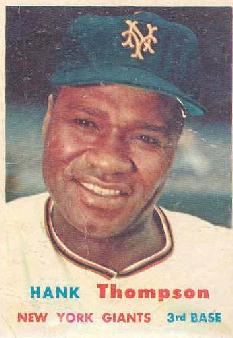 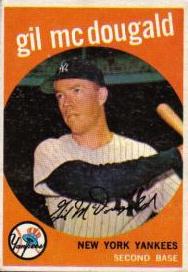 Gil
'n Hank: Gil
'n Hank:
Best DP Combo Ever?
by Doug Aiton
WASHINGTON (Sept. 1) -- On August 11, Gil McDougald strained his
tricep muscle, potentially ruling him out for the rest of the '59
season. There have been breaks before in the wonderful DP
combination that the Monuments have boasted for virtually all 8 UL
seasons (and 4 pennants) between himself and Hank Thompson --
indeed, Thompson missed 10 weeks in 1953 with a torn thigh muscle,
and missed much of '54 too - but this one could be terminal.
Hank Thompson's contract is up at the end of the year, and with cap
problems (alongside the specter of McDougald's contract ending next
year anyway) and decreased productivity, the new Monument management
has yet to commit to resigning him.
So
what was their best season, and are they the best DP combination in
UL history? One of the most impressive things of this eight-year
relationship is that the it has been so productive for so long.
In 1951, the inaugural year of the UL, Hank Thompson hit
.277/.363/.473 creating 86.3 Runs, while Gil McDougald was even
better .301/.384/.479, producing 97 runs, for a total 183.3 RC.
In '58, just last year, they were even better: McDouglald hit
.311/.394/.463 creating 97.7 runs, while Thompson hit even better:
.325/.379/.499, creating 98.6 runs, for a combined 196.3 RC.
Of
UL second basemen, three men have been All-Stars. The first
four awards went to the incomparable Jackie Robinson. But how
many great partners did Robinson play with all those years in New
York? In '51, he got a good .738 OPS with great defense from
the legendary Lou Boudreau, but Lou only played 114 games: the two
combined for 168.3 RC, 110 of them from Jackie. That was the
best production that the Gothams would get from Robinson's DP
partner until he left after 1955 -- he never hit over .250 again.
By '56 and '57, Jackie was good, but not great, and '51 remains
their most productive year.
Of
the great shortstops, had they ever produced enough with their
partner to qualify? Apart from McDougald, the three other
all-star shortstops are Vern Stephens, Ernie Banks and Granny
Hamner. The incomparable Hamner only became incomparable these
last three seasons, and ignoring this current one, what were his
partners like through '57 and '58? Well, his partner was Pete
Runnels, who was decent in '57 (.264/.355/.359, 45.7 RC) while
Hamner was awesome (.356/.393/.547, 127.7 RC), but the two combined
for only 173.4 RC, still a chunk away from McDougald/Thompson.
What about the inaugural all-star, Vern Stephens? Well, his
best chunk of uninterrupted play was in St. Louis between '53 and
'55. Vern, although very good, was never tremendous, producing
around 85 runs, and his playing partners, Red Schoendiest, Ed Stanky
et. al., while perfectly good players, were never his equal.
How about Ernie? "Mr. Colt" has been electric these
last four years. In 1956 alone, he created 128.5 runs by
himself, hitting .332/.364/.646. However, who pops up again as
semi-regular 2B but Red Schoendienst. Red hit just
.265/.287.355 in 330 ABs, creating 33.8 runs. That puts the
Ernie/Red combination at 162.3 runs, and even accounting for those
that took Red's place, Ernie+whomever falls behind the Monuments'
pair. In '57, Ernie had another great year (102
RC), but had such a myriad of DP partners that it seems unfair to
credit them as an actual combination (and once again, the combined
RC falls short of 198). Same goes for '58 (and 59?), a myriad
of guys provide good support to Ernie, but not quite great.
The
evidence suggests it's time to crown McDougald and Thompson the
best DP combination in UL history thus far. With difficult
decisions facing Washington -- along with these two, fan favorites
Stu Miller and Billy Goodman's contracts are both reaching an end --
we may have seen the last double-play this historic pair will ever
turn together.
|


