|
|
 Why
the West Is Best Why
the West Is Best
by
Glen Reed
Long-time UL participants will remember the
discussion of several seasons back about the pitiful
state of the West. Articles ran with titles like
Weak-Tit West, The East is the Dog's Bollocks, W =
Worst (oh, wait, that was actually an article about
George Bush), and West-Side Ball Lickers. Well, if
they didn't actually exist, they should have. Only
Chicago was deemed worthy of an East conversation
that included early UL dynasty teams Monuments and
Superbas, the pitching juggernaut by the lake, and
what were resurgent, winning sides in Boston and
Detroit.
But
times they are a changin'. The great Greek
Pythagoras tells us the two best teams in 1967
were western powers LA and Atlanta. A
sum-of-talents analysis leads you to the same
conclusion again heading into 1968. UL royalty
Colts have posted a winning record every year
this decade, a run that seems set to continue.
The division is not only top heavy, but also has
surprising depth. Indeed, five of the top-six
farms in the game are western affiliates, and
what I consider the top two farms belong to
Spiders and Maroons, which feature many of the
best young offensive spects in the league.
Now
consider the 1968 draft, which sports a deep and
talented table of UL-ready hurlers. An
incredible 12 of the first 15 pitchers off the
board went to West sides (counting Pattin in
this total, after his draft-and-trade from BRO
to ATL). You'll see Moose, Ryan, Pattin, Reed,
Bahnsen, Bosman, Lyle, Ray, Paul, and perhaps
also Dobson, Walker, and Romo step directly from
the draft into West division Opening Day staffs.
What's even more frightening for prospective
division winners--this immense influx of talent
is being added to what was a table already
stocked with four of the top-six pitching sides
in the entire league. Indeed, four of the
top-five bullpens in the UL call the West home.
So why did five of the first six relievers
drafted go to West sides? Call it the inexorable
logic of the arms race. Each side is seeking
escalation dominance in a struggle that may or
may not land them the West division pennant, but
must certainly put them further and further
ahead of those East division patsies.
|
|
|
 Feds,
Mons Foot Hefty Arbitration Bills Feds,
Mons Foot Hefty Arbitration Bills
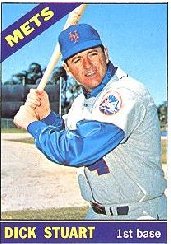
Dick Stuart
Rakes in $5 Million
NEW YORK (Nov. 1) -- The payrolls of the
Boston Federals and Washington Monuments increased by $6 million and
$5 million respectively, as the stroke of pen of the arbitration
committee today. Boston took five players to arbitration, led
by catcher Bill Freehan, who got a $3.8 million raise to $4.3
million, and starting pitcher Chris Short, who jumped from $1
million to $3.36 million. Freehan was the biggest gainer in
terms of absolute and percentage increase, but Washington first
baseman Dick Stuart walked away with the biggest paycheck: $5.168
million, the second highest award in the four-year history of
arbitration. Washington took six players to the panel, half of
which got at least one-million dollar raises: Stuart, third baseman
Ron Santo (2600 to 3884), and right fielder Floyd Robinson (1815 to
4531). Los Angeles CF Don Demeter (4807), Cleveland CF Curt
Flood (4765), Brooklyn 1B Jim Gentile (4743), and Robinson round out
the top five contract awards.
Forty players went to arbitration this year, the most in UL history.
The average award was 2514, also an record, for an average raise of
39 percent, lower than last year's 71 percent. 80 percent of
the players came from just five clubs (Cleveland 8, Brooklyn 7,
Dallas 6, Washington 6, Boston 5). Atlanta, Chicago,
Manhattan, San Francisco, and St. Louis took just one player each to
arbitration, while Los Angeles took three and Detroit took none.
Other records of note: nine players were awarded over $4 million, 22
players were awarded at least $1 million. 16 of the 40 players
were handed salary cuts, including 12 who were given the maximum cut
of 20 percent over their current salary. Complete arbitration
results are listed below.
Timbers,
Trappers in Triple-A
Relocations, Realignments Change
Int'l League
  NEW
YORK (Feb. 1) -- Two clubs will relocate and the league will
scrap its three-division format in favor of a single
division, as the International League restructures for its
sixth season. The Seattle Totems and Buffalo Bisons,
the circuit's most troubled franchises, skipped town in
search of greener pastures, to the benefit of Portland,
Oregon and St. Paul, Minnesota. The Portland Timbers
and Twin Cities Trappers will take the field on April 1 --
an earlier start in a move to finish the Governor's Cup
before September 1, the roster expansion date. NEW
YORK (Feb. 1) -- Two clubs will relocate and the league will
scrap its three-division format in favor of a single
division, as the International League restructures for its
sixth season. The Seattle Totems and Buffalo Bisons,
the circuit's most troubled franchises, skipped town in
search of greener pastures, to the benefit of Portland,
Oregon and St. Paul, Minnesota. The Portland Timbers
and Twin Cities Trappers will take the field on April 1 --
an earlier start in a move to finish the Governor's Cup
before September 1, the roster expansion date.
Seattle was one of the worst teams in the IL's first five seasons,
both on the field and at the box office, and the club's
owners capitalized on the expiration of their five-year
lease to shop the team to aspiring Triple-A cities,
including Edmonton, Albuquerque, and the eventual winner
Portland. Jeff Tonole, GM of the Timbers' parent club
San Francisco, lamented the move of the club from his home
town of Seattle, but was given assurances that league
officials will work to replace the departed Totems.
Buffalo was a terrible team in its first two seasons (44-86 and
36-94), and although they improved on the field, their
attendance plummeted in the last two years, prompting the
Brooklyn Superbas farm club to vacate Offermann Stadium.
The club considered Cincinnati and briefly looked at Mexico
City before settling on Nicollette Stadium in St. Paul,
Minnesota.
The league will scrap its divisional format and go with a 12-team
league with the top four clubs advancing to the playoffs.
UL Commissioner Timothy Smith called the IL a "testing
ground" for new ideas, adding that the elimination of
divisions was a short-term experiment and that the
distribution of teams made the three-division format
geographically unworkable. Smith also indicated that
the next two UL expansion teams would be chosen from the
most successful IL cities, based on on-field and off-field
performance. In its first five years, the Havana Sugar
Kings have been the winningest team, and the Denver
Grizzlies the most profitable. But Smith added that
only performance from 1968 forward would be considered. |
|
1968 |
|
|
|
|
|
|
|
40 players |
|
|
|
|
|
|
|
|
|
Old |
New |
Change |
% |
|
|
1B Dick Stuart |
WAS |
4112 |
5168 |
1056 |
25.7 |
|
|
CF Don Demeter |
LA |
4198 |
4807 |
609 |
14.5 |
|
|
CF Curt Flood |
CLE |
4114 |
4765 |
651 |
15.8 |
|
|
1B Jim Gentile |
BRO |
2400 |
4743 |
2343 |
97.6 |
|
|
RF Floyd Robinson |
WAS |
1815 |
4531 |
2716 |
149.6 |
|
|
1B Norm Cash |
CHI |
2500 |
4512 |
2012 |
80.5 |
|
|
C Bill Freehan |
BOS |
500 |
4332 |
3832 |
766.4 |
|
|
LF Boog Powell |
DAL |
1300 |
4275 |
2975 |
228.8 |
|
|
SS Dick Howser |
WAS |
4650 |
4214 |
-436 |
(9.4) |
|
|
3B Ron Santo |
WAS |
2600 |
3884 |
1284 |
49.4 |
|
|
2B Bernie Allen |
CLE |
1000 |
3868 |
2868 |
286.8 |
|
|
SP Chris Short |
BOS |
1000 |
3360 |
2360 |
236.0 |
|
|
MR Larry Sherry |
ATL |
1300 |
2244 |
944 |
72.6 |
|
|
1B Marv Throneberry |
DAL |
2604 |
2083 |
-521 |
(20.0) |
|
|
MR Jim Perry |
BRO |
2581 |
2065 |
-516 |
(20.0) |
|
|
3B Pete Rose |
SF |
1300 |
1988 |
688 |
52.9 |
|
|
LF Chuck Hinton |
CLE |
2250 |
1800 |
-450 |
(20.0) |
|
|
MR Turk Farrell |
CLE |
2200 |
1760 |
-440 |
(20.0) |
|
|
MR Dave Sisler |
BRO |
1950 |
1560 |
-390 |
(20.0) |
|
|
MR Terry Fox |
CLE |
500 |
1155 |
655 |
131.0 |
|
|
MR Taylor Phillips |
DAL |
1427 |
1142 |
-285 |
(20.0) |
|
|
MR Bob Trowbridge |
DAL |
1328 |
1063 |
-265 |
(20.0) |
|
|
SP Bud Daley |
WAS |
666 |
992 |
326 |
48.9 |
|
|
C Dick Brown |
STL |
700 |
885 |
185 |
26.4 |
|
|
SS Zoilo Versalles |
DAL |
500 |
870 |
370 |
74.0 |
|
|
1B Frank Torre |
BRO |
750 |
806 |
56 |
7.5 |
|
|
1B Jim Hickman |
BRO |
1000 |
800 |
-200 |
(20.0) |
|
|
MR Marshall Bridges |
WAS |
954 |
763 |
-191 |
(20.0) |
|
|
CF Jim Landis |
DAL |
450 |
720 |
270 |
60.0 |
|
|
C Earl Averill |
LA |
840 |
672 |
-168 |
(20.0) |
|
|
C Russ Nixon |
CLE |
310 |
600 |
290 |
93.5 |
|
|
CF Willie Tasby |
MAN |
400 |
563 |
163 |
40.8 |
|
|
3B Andy Carey |
LA |
437 |
513 |
76 |
17.4 |
|
|
CF Willie Davis |
BOS |
500 |
476 |
-24 |
(4.8) |
|
|
LF Harry Anderson |
BRO |
480 |
476 |
-4 |
(0.8) |
|
|
CF Lee Maye |
CLE |
400 |
450 |
50 |
12.5 |
|
|
2B Roy McMillan |
CLE |
300 |
405 |
105 |
35.0 |
|
|
2B Chuck Schilling |
BOS |
500 |
400 |
-100 |
(20.0) |
|
|
SP Ken Johnson |
BOS |
480 |
384 |
-96 |
(20.0) |
|
|
3B Ken Boyer |
BRO |
435 |
365 |
-70 |
(16.1) |
|
|
|
|
57731 |
80459 |
22728 |
39.4 |
|
|
Average |
|
1804 |
2514 |
710 |
|
|
|
|
| |
|
1968 Free Agent Auction
ATLANTA HILLTOPPERS
Cap Space: 0
Players Needed: 0 |
BOSTON
FEDERALS
Cap Space: 4686
Players Needed: -1 |
BROOKLYN SUPERBAS
Cap Space: 8470
Players Needed: -1 |
CHICAGO COLTS
Cap Space: 2390
Players Needed: 0 |
LF Norm Siebern (2330/3)
3B Eddie Mathews (1710/5)
LF Dick
Williams (1501/1)
MR Frank Linzy (510/5)
SP Steve Hargan (433/2)
SP Catfish Hunter (433/2)
2B
Hector Lopez (426/1)
SP Jim Lonborg (353/2)
CF Paul
Blair (333/3)
C Ron Brand (333/2)
SS Don Kessinger (333/3)
SP Mel Stottlemyre (333/2)
RF Tommy Harper (333/3)
SP Marcelino Lopez (310/2)
2B Jake Wood (305/1)
SP Tom Kelley (300/1)
|
MR Ray Narleski (4050/2)
MR Bill
Fischer (1420/2)
2B
Granny Hamner (1420/1)
1B Joe Cunningham (1000/1)
SS Ron
Hansen (680/2)
SP Glen
Hobbie (510/2)
MR Billy Hoeft (300/1)
SP Ray
Herbert (300/1)
|
SP
Whitey Ford (*3520/1+M)
SS Woodie Held (*1100/2)
C Ed
Bailey (1050/1)
SP Bob Purkey (*980/1+M)
RF Leon Wagner (*770/1+M)
3B Ed
Charles (*600/2+M)
2B Wayne Causey (*300/3)
|
SP Billy
O'Dell (5370/3)
LF Lee
Walls (982/1)
SP Herb Score (700/3)
MR Hal
Reniff (500/1)
MR Darold Knowles (495/1)
LF Ted
Savage (336/3)
RF Tommy
Davis (341/1)
CF Jose Cardenal (330/1)
SS Gene
Michael (303/1)
SP Al
Downing (300/1)
LF
Johnny Briggs (300/1)
|
CLEVELAND BARONS
Cap Space: 690
Players Needed: 0 |
DALLAS TEXANS
Cap Space: 7877
Players Needed: 0 |
DETROIT GRIFFINS
Cap Space: 6140
Players Needed: 0 |
LOS
ANGELES OUTLAWS
Cap Space: 648
Players Needed: 1 |
SS
Harvey Kuenn (4760/1)
RF Johnny Callison (*3800/5)
MR Dean Stone (*1700/3)
SP Stan Williams (*1200/4)
SP Dave
Boswell (300/1)
C Hawk Taylor (*300/3)
3B Rich Rollins (300/1)
SP Fred
Talbot (300/1)
|
2B Bill
Maseroski (4500/1)
CF Lenny Green (1500/1)
|
|
|
MANHATTAN GRAY SOX
Cap Space: 5677
Players Needed: -2 |
ST.
LOUIS MAROONS
Cap Space: 3925
Players Needed: 0 |
SAN FRANCISCO SPIDERS
Cap Space: 4072
Players Needed: 0 |
WASHINGTON MONUMENTS
Cap Space: 4859
Players Needed: 1 |
MR Ray
Crone (2500/2+T)
MR Bob Grim (2500/2+T)
SS Tony Kubek (350/1)
LF Roman Mejias (300/1)
|
C Johnny
Romano (2875/1)
1B Davey Williams (1860/1)
SP Lew Burdette (1625/1)
SP Tom
Sturdivant (1350/1)
2B Ted
Lepcio (840/1)
RF Wally Post (755/1)
MR Bob Chakales (600/1)
LF Billy Cowan (395/1)
SP Larry Jackson (340/1)
MR Pete Mikkelsen (300/1)
MR Steve
Ridzik (300/1)
MR Cloyd Boyer (300/1)
1B Steve Bilko (300/1)
|
|
SS Rocky
Bridges (999/1)
C Del Crandall (999/1)
SP Dick
Hughes (800/1)
SP Dick
Donovan (600/1)
2B Gil McDougald (500/1)
RF
Johnny Blanchard (400/1)
1B Bob Skinner (400/1)
MR Gordon Jones (400/1)
2B Joey Amalfitano (400/1)
SP Bill
Monbouquette (400/1)
|
|
|
Trades |
|
January
21 (173)
ATLANTA gets
SP Jim Perry
BROOKLYN gets
SP Woodie Fryman
RF Ollie Brown
March
1 (174)
DETROIT
gets
RF Reggie Jackson
WASHINGTON gets
LF
Cleon Jones
MAN '68 2nd round pick (#18)
|
March 1 (175)
ATLANTA
gets
SP Marty Pattin
BROOKLYN
gets
2B Jim Lefebvre
ATL '69 1st round pick
ATL '69 2nd round pick
ATL '69 3rd round pick
ATL '69 4th round pick
ATL '69 5th round pick
February
21 (176)
BROOKLYN
gets
$1 cash
LOS
ANGELES
gets
MR George Susce
CF Don Landrum
C Harry Chiti
|
March 1 (177)
DALLAS
gets
MAN '69 2nd round pick
MANHATTAN
gets
C Joe Azcue
SS Zoilo Versalles
March 1 (178)
BROOKLYN
gets
$1 cash
LOS
ANGELES
gets
2B Jim Lefebvre
|
April 1 (179)
CHICAGO
gets
2B Davey Johnson
SAN
FRANCISCO
gets
LF Ted Savage
April 1
(180)
CHICAGO
gets
C Clay Dalrymple
CLEVELAND
gets
C Jerry McNertney |
|
|
1968 Rookie Draft |
|
|
Round 1 |
|
Round 2 |
|
Round 3 |
|
Round 4 |
|
1 |
DAL |
C Johnny Bench |
13 |
DAL |
RF Willie Crawford |
25 |
DAL |
CF Del Unser |
37 |
DAL |
2B Sandy Alomar |
|
2 |
SF |
SP Bob Moose |
14 |
SF |
MR Jim Ray |
26 |
SF |
MR Vicente Romo |
38 |
SF |
CF Buddy Bradford |
|
3 |
STL |
SP Nolan Ryan |
15 |
LA |
MR MIke Paul |
27 |
STL |
C Ellie Hendricks |
39 |
STL |
2B Ken Boswell |
|
4 |
DET |
RF Bobby Bonds |
16 |
DET |
SP Dock Ellis |
28 |
DET |
MR Ed Sprague |
40 |
DET |
RF Bill Voss |
|
5 |
BOS |
SP Jerry Koosman |
17 |
SF |
SP Dick Bosman |
29 |
SF |
SS Mark Belanger |
41 |
BOS |
MR Mike Kekich |
|
6 |
MAN |
3B Sal Bando |
18 |
WAS |
LF Mike Lum |
30 |
DET |
2B Felix Millan |
42 |
MAN |
MR Dave Leonhard |
|
7 |
WAS |
RF Reggie Jackson |
19 |
WAS |
C Frank Fernandez |
31 |
BRO |
SP Tom Murphy |
43 |
WAS |
1B Rich Reese |
|
8 |
BRO |
SP Marty Pattin |
20 |
BRO |
C Dick Dietz |
32 |
BRO |
2B Dave Nelson |
44 |
BRO |
RF Andy Kosco |
|
9 |
CHI |
SP Ron Reed |
21 |
WAS |
3B Doug Rader |
33 |
WAS |
LF Brant Alyea |
45 |
DAL |
RF Dave Marshall |
|
10 |
LA |
SP Stan Bahnsen |
22 |
LA |
C Dave Duncan |
34 |
DAL |
MR Jerry Johnson |
46 |
LA |
SS Jackie Hernandez |
|
11 |
MAN |
MR Cecil Upshaw |
23 |
STL |
SP Pat Dobson |
35 |
LA |
MR Tom Burgmeier |
47 |
CLE |
2B Paul Popovich |
|
12 |
STL |
MR Sparky Lyle |
24 |
STL |
MR Luke Walker |
36 |
BRO |
SP Clyde Wright |
48 |
STL |
SS Hector Torres |
Because Nobody Asked for
this Either--Kel Muiper's Draft Grades
by Glen Reed
I was
too swamped or out of it to do a pre-draft analysis, so here's
Mel's bald brother Kel's assessment of the 1968 UL entry draft.
By hook or by crook, Kel finagled some time at Stanford, so he
knows a thing or two about grade inflation--nobody gets an "F"
and the curve leans heavily to the left.
DETROIT
-- "A" Boxers or briefs? Tastes great, or less filling? Pamela
or Carmen? Bonds or Reggie? Fuck that, give me both!!! And for
good measure, throw on Ellis at #16--the Perry/Barber/Jay clone
came after a run of four MRs and some dude named Crawford. With
a little development, Bonds (#4) figures to be a rangey CF with
a gun, power, and wheels to boot. Reggie (#7) can provide the
lefty pop so long absent in Motown. Look ahead two seasons and
you can see a potent Griffin 1 through 6 that goes Menke, Yaz,
Allen, Reggie, Bonds, Howard, fronting a rotation of Ramos,
John, Jay, Ellis, and Hands. Rarely does a guy pull three legit
starters out of a draft; for that, the Griffs earn Kel's highest
grade.
SAN FRANCISCO
-- "B+" on the strength of Moose, regarded by many as the best
SP in the draft, and Bosman, regarded by some as the swoop of
the draft. But Kel can't give an "A" because he has a thing
against drafting relievers too high (Ray at #14). And that's
especially true in this case, because the Spiders already had
the best young 'pen in the game last year, and a pre-draft trade
brought, guess what?, a solid MR spect in the form of Zachary.
To top it all off, the best C-spect not named Bench was still on
the board in the form of Dave Duncan, and at a position of need.
ST. LOUIS
-- "B+" A Maroon side with some of the very best young
positional spects in the game used picks #3, 12, 23, and 24 to
add hurlers to a staff that finished one off the bottom in 1967.
So many peeps were down on Ryan (#3 overall) for his bum
control, but Smith gets props for snagging one of only two SPs
in the draft with talent that summed to 12, including the
all-important 5 for movement. And Dobson at #23 brings talent
comparable to some late first-round picks, making for a great
value play. But much like SF, the use of a first (Sparky Lyle
#12) to draft a reliever earns a demerit, especially following a
recent first-rounder used to acquire the team's current closer.
But overall, a draft that should provide immediate and lasting
succor to baseball fans from Wien to the Gateway City.
BOSTON
-- "B" The Feds had
but one pick in the first three rounds, but what a winning
selection it was. Koosman (#5) partners other recent high
draftees Nolan and Cuellar to form, along with Chris Short, what
is easily the best rotation in Federales history.
DALLAS
-- "B" is for Bench. I know what you're thinking--how can a guy
that talked up Bench like the second-coming only give the team
that selected him a "B"? Mostly because the rest of the Dallas
draft is reminiscent of a college roommate's infamous Salvador
Dali poster--intriguing, but ultimately off-putting. True, OF
was an area of need, but Crawford (#13 overall) and Unser (#25)
sound more like NASCAR drivers than two-thirds of a
pennant-winning outfield. Pundits had been calling for Ellis or
Bosman in Crawford's spot to meet another glaring need--viable
hurlers.
LOS ANGELES
-- "B" Kel's a fan of the dong . . . um, anyhoo, when it comes
to pitching, he wants guys that can suppress dongs, and that
requires movement talent; as a result, he favored Ellis over
Bahnsen in the #10 spot. Bahnsen is cut from the same 2/4/4
cloth as a bunch of other guys in the draft, to say nothing of
Big Red McGlothlin, last year's 2/4/4 first-rounder and this
year's fourth starter. And we already know how Kel feels about
taking relievers early (Paul #15); nevertheless, these picks do
fill gaping holes (no dong jokes, please), so some pundits quite
like the Bandit draft to this point. But the real heist was the
Outlaws making off with the aforementioned Duncan at #22,
addressing perhaps the one weakness in LA's deep system,
catcher.
CHICAGO
-- "B-" The
Ponies had but one pick in the draft, and used it to take Ron
"Don't Call me Glen" Reed (#9), the best of the 2/4/4 starters
popping up all over this and other drafts like those retarded
zombies in "Night of the Living Dead." Reed's ratings sum to 21,
which is great, but one wonders how long he can defy talent
gravity before coming back down to earth, much like Wilbur "Woke
up with" Wood, last year's #1 selection currently laboring in
the long relief role. Truly, no knock on Colts, but a problem
endemic to every draft since switching either eras or games
going back to OOTP 2007 is the omnipresent 2/4/4 starter.
They're everywhere, like so many pork chop bones at a baptist
picnic. But if everyone has them, how good are they really? In
other words, in absolute terms, it's good to have a 20- or
21-rated starter. But in relative terms, essentially every team
(except Texans and Monuments) has a 2/4/4 20-rated fourth
starter. So I guess as long as Reed can hang on to that extra
point, he's better than those guys, but the history of 2/4/4
dudes suggests an eventual return to the pitching pack.
MANHATTAN
-- "B-" There's a
theory that the Gray Sox biggest need was on the mound, so how
disappointing to see the big three SPs go in front of them. But
what a consolation prize--in Sal "3/4/4" Bando (#6), the
cosmopolitans landed the single most talented position player in
the draft (setting aside the brutal 2/4/5 of Frank Fernandez),
who also happens to ply his trade at a premium position. But
with their only other selection in the first three rounds, the
Gray Sux committed the cardinal sin in Kel's eyes of using pick
#11 on an MR, despite the presence of viable SP candidates still
on the board, to say nothing of Willie Crawford (!).
WASHINGTON
-- "D" because
nobody who pays that much in tuition gets an F, but fudge!!! As
a long-time supporter of Aiton and someone who's seen the savvy
Scott operate in other leagues, this one was a head-scratcher.
Analysts were calling for Pattin to partner the emerging star
Jim Nash and put an end to those chants of "We want a pitcher,
not a belly-itcher" echoing around Griffith Stadium. Indeed, the
Mons were second in the league in runs scored in 1967, but dead
last in runs allowed. Nevertheless, the Glasgow dandy used fully
five picks to select positional spects. What's more, the lefty
power-poking Reggie Jackson was taken seventh overall, only to
be traded for . . . a lesser pick and positional spect. In the
immortal words of Twiki, "Bidi, bidi, Buck?"
BROOKLYN
-- "Incomplete" The
draft-and-trade of Pattin (#8) leaves this one an open question
pending the outcome of Atlanta's picks this time next year. The
take on the second-round selection of backstop Dietz is also
inconclusive--Kel has a mancrush on Duncan, but can see how a
guy could prefer Dick. A Dietz/Josephson platoon in future years
looks partiuclarly promising, assuming a trade of the frankly
disappointing McCarver.
|
|