|
 H A L L O F F A M E I N D U
C T E E S
H A L L O F F A M E I N D U
C T E E S
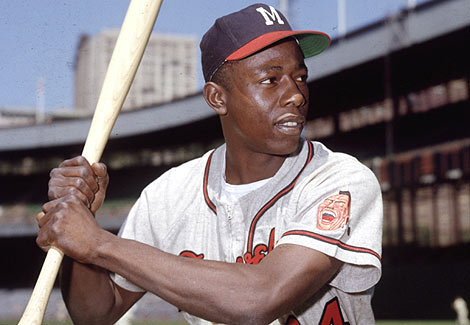 Hank Aaron
·
Elected 1974 Hank Aaron
·
Elected 1974
Left Fielder, Louisville Colonels, Los Angeles Outlaws, Brooklyn Superbas,
Chicago Colts ·
1955-1973
When the phrase
"Five-Tool-Player" was coined, the coiners couldn't have forseen the
emergence of the mightiest tool of all: The Hammer! Henry Louis
"Hank" Aaron came to the United League full of promise, picked by the
Louisville Colonels as the number one overall pick in the 1954 Rookie
Draft. On the other side of eighteen seasons, Aaron surfaced as simply
one of the best who ever played the game.
As a 21-year-old rookie
in 1955, the Hammer proved that he deserved to be in the bigs, but this
wasn't just a supreme power threat, this was a superb athlete that could
hit for average and get on base with the best of them. Need more tools?
Just add wicked speed, golden glovework and an arm that made base
coaches extra cautious. He spent 8 1/2 years in Louisville and was part
of the magical 1958 Championship season before becoming part of the
infamous teardown that heralded the beginning of the end for former
Colonels GM, Mark Allen. Aaron was traded to the Los Angeles
Outlaws midway through the 1963 season. In 1964, his first full season
as an Outlaw, he crushed a record breaking 50 home runs, a record that
was recently tied by Denver's Tom Grieve (with the help of some rarified
air). In 5 1/2 seasons as an Outlaw, although he saw a drop off in his
usual production, he was still great. Released by the 'Laws after 1968,
free agent Aaron found a new home in Brooklyn, still pulling in over $10
million per year, though it was becoming clear he was not the same
player he once was, but diminishing Hank Aaron skills are still
preferable to most of those in their prime. The Chicago Colts signed him
in 1972, continuing the money train, but the end was clearly near. Aaron
took his 1973 World Series ring and hung up his spikes, leaving a ton of
money on the table, but clearly knowing when to make his exit.
Hank Aaron's two world championships were only the beginning of the
hardware to be bestowed upon him. In eighteen seasons, he was named
Player of The Week eleven times and Batter of the Month thrice. He was a
five time All-UL team member and made five All-Star game appearances.
Though he had better seasons, his only MVP trophy came in 1960 as a
Colonel. He hit over 30 home runs in a season nine times, finishing his
career with 535 clouts. He turned in over a hundred RBI's in six
different seasons, ending his career with 1630. As an outfielder, he
racked up eight Gold Glove Awards, including a run of five-in-a-row from
'58-'62.
Hank Aaron finshed his career near the top of most
indivdual leaderboards. As of his retirement, Aaron was 2nd overall in
Games Played, At-Bats and Total Bases, 3rd in Runs, Hits and Home Runs,
4th in RBI's, and 5th in triples. And in case you thought his damage was
all done with the bat, he also finished 7th overall in Stolen Bases and
Walks. His inclusion into the United League's Hall of Fame seems like a
foregone conclusion. Either way, Hank's for the memories, and we're
still calculating just how many tools the Hammer had in his tool box.
(Charlie Qualls)
AWARDS &
ACCOLADES
Most Valuable Player (1960)
All-UL Team (1958, 1960,
1961, 1962, 1964)
Gold Glove Award (1956, 1958, 1959, 1960, 1961,
1962, 1967, 1971)
Batting Champion (1960)
Home Run Champion (1961,
1964)
RBI Champion (1964), OPS Champion (1961)
4-time Batter of
the Month, 11-time Player of the Week
| Career Batting Stats |
| Year/Team |
Age |
G |
AB |
H |
2B |
3B |
HR |
RBI |
R |
BB |
K |
SB |
CS |
AVG |
OBP |
SLG |
OPS |
RC |
|
1955 Louisville |
21 |
85 |
274 |
77 |
10 |
5 |
19 |
59 |
54 |
19 |
28 |
18 |
9 |
.281 |
.328 |
.562 |
.890 |
47.1 |
|
1956
Louisville |
22 |
147 |
572 |
162 |
42 |
7 |
26 |
94 |
93 |
45 |
64 |
49 |
5 |
.283 |
.335 |
.517 |
.853 |
101.1 |
|
1957
Louisville |
23 |
149 |
556 |
165 |
29 |
6 |
35 |
94 |
113 |
54 |
62 |
53 |
10 |
.297 |
.359 |
.559 |
.918 |
111.2 |
|
1958
Louisville |
24 |
149 |
566 |
177 |
39 |
4 |
30 |
111 |
110 |
62 |
60 |
47 |
11 |
.313 |
.381 |
.555 |
.935 |
119.8 |
|
1959
Louisville |
25 |
149 |
547 |
162 |
28 |
8 |
26 |
86 |
95 |
57 |
52 |
35 |
12 |
.296 |
.364 |
.519 |
.883 |
104.5 |
|
1960
Louisville |
26 |
150 |
583 |
199 |
24 |
6 |
36 |
110 |
119 |
45 |
49 |
55 |
5 |
.341 |
.392 |
.588 |
.980 |
137.6 |
|
1961
Louisville |
27 |
147 |
566 |
178 |
33 |
3 |
42 |
106 |
109 |
64 |
58 |
38 |
10 |
.314 |
.383 |
.606 |
.989 |
133.6 |
|
1962
Louisville |
28 |
155 |
600 |
175 |
37 |
8 |
37 |
100 |
108 |
71 |
57 |
57 |
15 |
.292 |
.366 |
.565 |
.931 |
125.3 |
|
1963 Louisville |
29 |
79 |
306 |
97 |
11 |
3 |
13 |
47 |
57 |
46 |
30 |
9 |
2 |
.317 |
.406 |
.500 |
.906 |
63.5 |
|
1963 Los Angeles |
29 |
72 |
271 |
68 |
14 |
3 |
19 |
43 |
48 |
32 |
31 |
6 |
1 |
.251 |
.337 |
.535 |
.872 |
49.3 |
|
1963 Total |
29 |
151 |
577 |
165 |
25 |
6 |
32 |
90 |
105 |
78 |
61 |
15 |
3 |
.286 |
.374 |
.516 |
.890 |
113.1 |
|
1964 Los Angeles |
30 |
153 |
595 |
178 |
25 |
5 |
50 |
139 |
108 |
68 |
47 |
20 |
6 |
.299 |
.370 |
.610 |
.980 |
130.3 |
|
1965 Los Angeles |
31 |
151 |
587 |
182 |
27 |
2 |
28 |
89 |
100 |
78 |
70 |
22 |
5 |
.310 |
.397 |
.506 |
.903 |
118.1 |
|
1966 Los Angeles |
32 |
151 |
626 |
161 |
23 |
3 |
33 |
77 |
93 |
63 |
44 |
20 |
6 |
.257 |
.330 |
.462 |
.792 |
92.5 |
|
1967 Los Angeles |
33 |
132 |
528 |
146 |
20 |
2 |
30 |
88 |
86 |
56 |
52 |
15 |
7 |
.277 |
.349 |
.492 |
.841 |
89.9 |
|
1968 Los Angeles |
34 |
103 |
403 |
109 |
13 |
4 |
19 |
59 |
73 |
51 |
31 |
15 |
1 |
.270 |
.357 |
.464 |
.821 |
68.3 |
|
1969 Brooklyn |
35 |
155 |
565 |
161 |
29 |
5 |
24 |
100 |
95 |
76 |
53 |
14 |
9 |
.285 |
.373 |
.481 |
.854 |
100.3 |
|
1970 Brooklyn |
36 |
113 |
419 |
98 |
9 |
1 |
17 |
43 |
48 |
41 |
48 |
9 |
3 |
.234 |
.303 |
.382 |
.685 |
48.4 |
|
1971 Brooklyn |
37 |
157 |
601 |
140 |
21 |
3 |
23 |
84 |
69 |
72 |
57 |
11 |
8 |
.233 |
.317 |
.393 |
.709 |
74.8 |
|
1972 Chicago |
38 |
140 |
487 |
106 |
22 |
4 |
16 |
58 |
77 |
57 |
46 |
21 |
8 |
.218 |
.303 |
.378 |
.681 |
52.3 |
|
1973 Chicago |
39 |
120 |
360 |
70 |
15 |
2 |
12 |
43 |
42 |
54 |
39 |
14 |
4 |
.194 |
.301 |
.347 |
.648 |
39.4 |
| Total UL |
|
2657 |
10012 |
2811 |
471 |
84 |
535 |
1630 |
1697 |
1111 |
978 |
528 |
137 |
.281 |
.354 |
.505 |
.859 |
1790.8 |
|
