|
 M E E T T H E R O O K I E S
· 1 9 6 2
M E E T T H E R O O K I E S
· 1 9 6 2
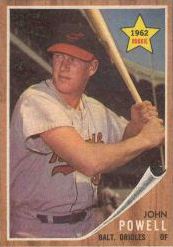 Boog
Powell ·
#1 overall, Dallas Texans Boog
Powell ·
#1 overall, Dallas Texans
An immense lefthanded slugger, Powell batted cleanup for the Orioles for
over a decade and helped them to the WS four times in six years from
1966 to 1971. Standing slightly over 6'4" and weighing at least 230 lb,
Powell had bulging biceps and a thick neck, as well as a
youthful-looking face topped by a shock of reddish hair. He batted
behind
Frank Robinson beginning in 1966 to form half of Baltimore's
fearsome power combination, and in the field he was an ample target at
first base as well as a master at scooping low throws from the dirt.
Powell joined the
Orioles after leading the International League in home runs at Rochester
in 1961, and spent his first three seasons as a slow-footed left fielder
before switching to first base in 1965. Offensively, he was an immediate
success, hitting 25 HR in 1963, then leading the AL in slugging
percentage (.606) in 1964 while blasting a career-high 39 HR despite
missing several weeks because of a broken wrist. He slumped to .248 with
17 HR in 1965, then won AL Comeback Player of the Year honors in 1966
(.287, 34 HR, 109 RBI) while being hampered by a broken finger.
Before the 1967 season,
Powell lamented, "Once, just once, I'd like to through a whole season
without an injury," and he did just that, playing over 150 games each of
the next three seasons. In 1968 he hit a career-high .304 with 37 HR and
121 RBI, and in 1970 he was the AL MVP, narrowly missing a .300 average
on the last day of the season and hitting 35 more HR with 114 RBI. In
the WS, Powell homered in the first two games as the Orioles whipped the
Reds. Powell helped Baltimore to a third straight WS the following year,
blasting a pair of home runs in Game Two of the ALCS, but he hit only
.111 in the WS as Baltimore lost to Pittsburgh in seven games.
The aging slugger was
traded to Cleveland with
Don Hood for
Dave Duncan and a minor leaguer before the 1975 season, and he hit
.297 with 27 HR for the Indians that year, but he hit only nine home
runs in 1974 and none as a pinch hitter for the Dodgers in 1975. Powell
hit three home runs in a game three times, and is second only to
Eddie Murray on the Orioles all-time home run list.
(SCL)
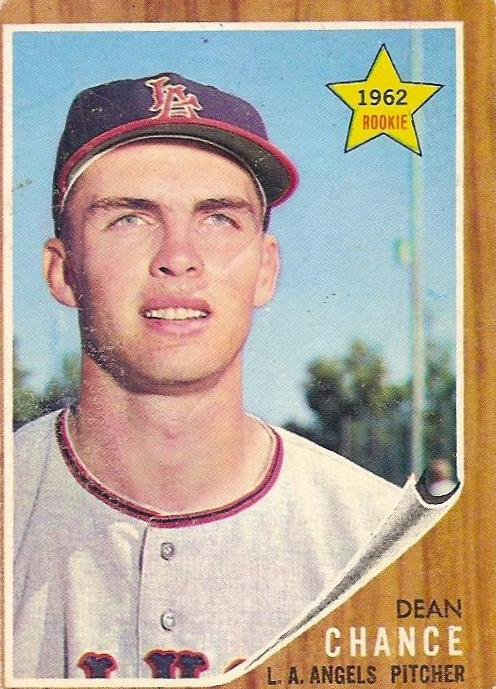 Dean
Chance
· #2 overall,
Manhattan Gray Sox Dean
Chance
· #2 overall,
Manhattan Gray Sox
A hard-throwing righthanded starter with an unorthodox twisting windup,
Chance won the AL Cy Young Award in 1964 at the age of 23 but never
evolved into a consistently dominating pitcher. With a touch of wildness
and the disconcerting habit of never looking at home plate once he
received the sign from his catcher, Chance would turn his broad back
fully towards the hitter in mid-windup before spinning and unleashing a
lively fastball, good sinker, or sidearm curve.
Chance was drafted by
the
Los Angeles Angels from the Orioles organization in the 1960
expansion draft and as a rookie in 1962 was 14-10, 2.96 as an
occassional starter for the Angels. He began taking regular turns in the
rotation in 1963 and was 13-18 with meager support from his teammates,
then in 1964 he blossomed into the AL's most overpowering pitcher.
Pitching his home games in spacious
Dodger Stadium, Chance was 20-9 with a 1.64 ERA in '64, and tossed
11 shutouts, including six in which he won 1-0. On June 6 that year he
pitched 14 shutout innings against the Yankees, only to see the Angels
lose 2-0 after he left the game, and on September 10 he pitched a
one-hitter against the Twins, allowing only an infield single to
Zoilo Versalles in the eighth.
Chance slipped to 15-10
in 1965 and 12-17 in 1966, and after he began to berate his temmates for
their poor play behind him was traded to Minnesota before the 1967
season. He enjoyed a resurgence with the Twins, going 20-14, 2.73 to win
AL Comeback Player of the Year honors and pitching a no-hitter against
the Indians August 25. On the final day of the regular season he faced
the Red Sox with a chance to clinch the pennant, but lost, sending
Boston to the WS instead. Chance was 16-16 in 1968 and 5-4 in only 15
starts in 1969, then was traded to the Indians along with
Graig Nettles in a six-player deal that brought
Luis Tiant to the Twins. The Indians sold Chance to the Mets in
mid-1970, and he spent his final season pitching mostly in relief with
the Tigers in 1971.
Chance was a
notoriously poor hitter, batting .066 in 662 career bats while striking
out 353 times. (SCL)
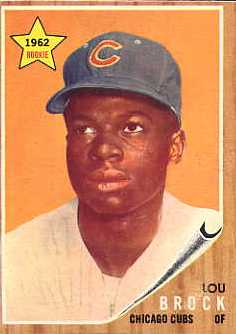 Lou
Brock
· #3 overall,
San Francisco Spiders Lou
Brock
· #3 overall,
San Francisco Spiders
Signed out of Southern
University for a $30,000 bonus in 1961, Brock moved up to the Cubs
within one season. He hit only .263 and .258 in two full seasons with
Chicago while showing flashes of both speed and power, including a
450-foot home run into the centerfield bleachers at the Polo Grounds,
one of only four homers ever to land there. He came into his own after
moving to St. Louis in a six-man trade on June 15, 1964. The deal was
essentially Brock for pitcher Ernie Broglio, and is regarded as one of
the worst the Cubs ever made. Brock averaged .348 in the 1964 stretch
drive and finished the season at .315, with 111 runs scored, 200 hits,
30 doubles, 11 triples, and 43 stolen bases. In fourth place when Brock
joined them, the Cardinals overtook the Phillies, Giants, and Reds to
claim the pennant in the last week of the season. Brock then batted .300
with a homer as the Cardinals beat the Yankees in the World Series. He
scored 107 runs and stole 63 bases in 1965, then won his first of four
straight and eight total stolen-base championships with 74 in 1966.
Brock's greatest season was probably 1967, when he led the Cardinals to
another World Championship with a league-leading 113 runs scored, 52
steals, and career highs of 21 homers, 76 RBI, and a .472 slugging
average. Brock batted .414 with seven steals against Boston in the WS,
breaking or tying four Series records. Although he slumped to .279 in
1968, Brock helped St. Louis win the pennant again by leading the NL in
doubles (46) and triples (14) as well as steals (62). The Cardinals lost
the World Series to the Tigers in seven games, but Brock was
sensational. He hit .464 to lead both clubs, with two homers and seven
steals. At that time he had the highest average (.391) of any player in
two or more World Series, along with a Series-record 14 steals. His .655
slugging average ranked fifth and his seven doubles ranked eighth. Brock
hit between .297 and .313 in each season from 1969 through 1976 and led
the NL with 126 runs in 1971. Former teammate Bobby Tolan edged Brock,
57 to 51, for the 1970 stolen- base championship, but Brock then won
four more titles in a row with 64, 63, 70 and 118. Brock's 118 steals in
1974 shattered Maury Wills's major league record of 104, set in 1962,
and remains the National league record through the 1980s (Rickey
Henderson broke the ML record with 130 in 1982). At 35, Brock was by far
the oldest man to steal 100 bases. "I figured it was now or never," he
said. He dropped off to "only" 56 steals in each of the next two
seasons. Dipping to .221 and 17 steals in 1978, Brock lost his regular
job and was urged to retire. Instead he rebounded to .304 with 21
steals, retiring first all-time in stolen bases with 938. He was elected
to the Hall of Fame in 1985, his first year of eligibility. Despite
Brock's high averages and electrifying feats on the bases, his stature
is disputed by baseball experts. He struck out over 100 times in nine
seasons, over 90 times in 12 seasons, and fanned more often than he
scored in 11 seasons. He also struck out 1,730 times career, the most
all-time at his retirement, while walking only 761 times, a poor ratio
for any player and horrendous for a leadoff man. Brock also led the NL
in errors seven times, including five years consecutively, never
committing fewer than 10 from 1964 through 1973. He was shifted from
centerfield to right before settling in left in 1966, primarily because
of his defensive shortcomings. (MC)
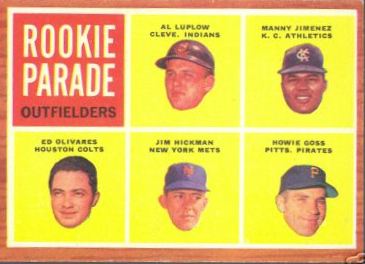 Jim
Hickman
· #4 overall,
Washington Monuments Jim
Hickman
· #4 overall,
Washington Monuments
This original New York
Met was both the first member of the franchise to hit for the cycle
(8/7/63) and the first to hit three home runs in a game (9/3/65). During
his first seven ML seasons Hickman was considered a clumsy outfielder
whose occasional power insufficiently compensated for frequent
strikeouts. The Cubs acquired him from the Dodgers in 1968, and he
batted a paltry .223. On August 1, 1969, he was down to .216 on the
first-place Cubs. While his teammates faltered in the stretch, Hickman
came off the bench to hit .301 for August, with 10 HR and 25 RBI. He
kept hitting well the next year with a .315 average, 32 HR, 115 RBI, and
13 game-winning hits. In the 1970
All-Star Game, his 12th-inning single drove in
Pete Rose for the game-winning run. He was slowed in ensuing years
by various ailments.
(AA)
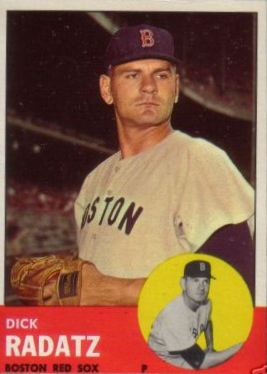 Dick
Radatz
· #5 overall,
St. Louis Maroons Dick
Radatz
· #5 overall,
St. Louis Maroons
This 6'6" 230-lb
flamethrower was a devastating reliever from the time he joined the Red
Sox in 1962 through 1965, saving 100 games in four years and winning 49
more. Radatz had unusually fine control for a one-pitch strikeout
artist. As a rookie in 1962, he led the AL with 62 appearances, nine
relief wins, and 24 saves to gain Fireman of the Year honors.
Radatz was even better
in 1963. He won 10 consecutive decisions on the way to a 15-6 record, a
1.97 ERA, and 25 saves. Yankee manager
Ralph Houk called him "the greatest relief pitcher I have ever
seen." Houk named him to the 1963 All-Star squad, and Radatz struck out
Willie Mays,
Dick Groat,
Duke Snider,
Willie McCovey, and
Julian Javier while working the last two innings. Another Fireman of
the Year season followed in 1964, when Radatz made 79 appearances and
led the league with 29 saves, 16 wins, and nine losses in relief. He
recorded a win or a save in 45 of Boston's 72 wins and struck out 181
batters in 157 innings. But he called the 1964
All-Star Game his biggest disappointment; he gave up a three-run
homer to
Johnny Callison with two out in the ninth to lose 7-4.
Radatz saved 22 in
1965, but by 1966 he was losing movement on his fastball, and he was
traded to Cleveland. Unable to convert to finesse pitching, he was out
of the majors in 1968. He resurfaced with the
1969 Tigers and finished with the expansion Expos. He never made a
start in 381 ML games, and he retired with 122 saves. (FK)
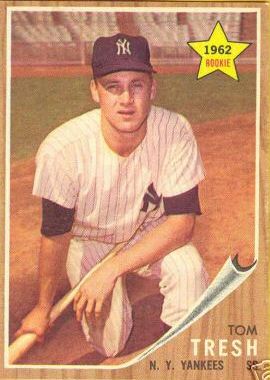 Tom
Tresh Tom
Tresh
#6
overall, Los Angeles Outlaws
Tresh, the son of
former ML catcher
Mike Tresh, was AL Rookie of the Year in 1962 when he hit .286, with
20 home runs and 93 RBI, as a switch-hitting Yankee shortstop when
Tony Kubek was in military service. Moved to left field in 1963 when
Kubek returned, he continued to hit homers, three times topping 25, but
his batting average declined steadily. On September 1, 1963 he became
only the eighth player to homer from each side of the plate in a single
game. He accomplished that feat twice more in his career, including a
June 6, 1965 doubleheader when he hit four home runs, three in the
nightcap. A damaged knee in 1967 hastened the end of his career.
(RTM)
|
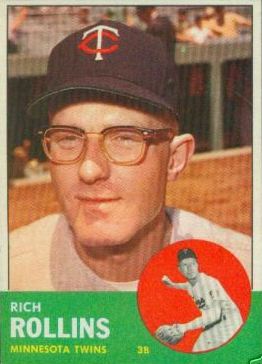 Rich
Rollins Rich
Rollins
#7 overall, Cleveland Barons
The stocky
redhead broke in with a strong rookie season in 1962 (.298, 16
HR, 96 RBI), receiving the most All-Star votes of any AL player
and starting both All-Star Games that year. He worked hard to
become an adequate third baseman and helped the Twins contend in
the 1960s. After hitting .307 in 1963, his average declined for
a ML-record seven consecutive years.
(JCA) |
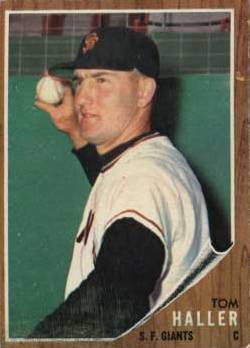 Tom
Haller Tom
Haller
#8 overall, Boston Federals
After a career at quarterback for the University of Illinois,
the 6'4" Haller signed with the Giants in 1958. In their
pennant-winning 1962 season, he hit 18 HR as a platoon catcher.
He was San Francisco's first-string receiver in the years
1964-67, and hit 27 HR in 1966. He went to the Dodgers in a 1968
trade for
Ron Hunt and Nate Oliver, the first trade between the two
clubs since 1956. In a ML first, on July 14, 1972, Tom was the
Tiger catcher while his brother, Bill, umpired behind the plate.
The durable Haller caught all 23 innings of a May 31, 1964
Mets-Giants game, and set the NL record for most double plays by
a catcher in a season (23, in 1968). After serving as a Giant
coach from 1977 to 1979, he was their vice president of baseball
operations from mid-1981 until September 1986.
(RTM)
|
|
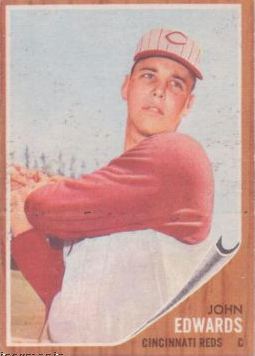 Johnny
Edwards Johnny
Edwards
#9 overall, Detroit Griffins
Edwards was a
durable, strong-armed, take-charge catcher whose intelligence
matched his fine physical ability. A 6'4" 220-lb graduate of
Ohio State, he set a ML season record for catchers' total
chances (helped by a pitching staff of strikeout artists) with
1,221 in 1969, his first year with Houston. When he retired five
years later, he held the NL career record for total chances by a
catcher (9,745), since broken by
Johnny Bench. Edwards won two Gold Gloves. As a rookie
playing in the 1961 New York-Cincinnati
World Series, he hit .364. He batted a career-high .281 for
the 1964 Reds and had his best HR season in 1965 with 17.
(TJ)
|
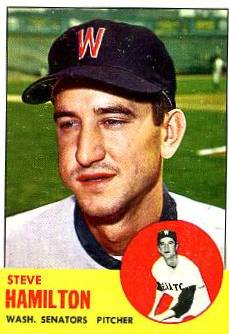 Steve
Hamilton Steve
Hamilton
#10 overall, St. Louis Maroons
An important
Yankee reliever who had played pro basketball with the
Minneapolis Lakers, the 6'6" Hamilton threw a nasty slider with
a three-quarter sidearm motion that froze lefthanded hitters. He
saved the sixth game of the 1964
World Series. In 1965, he recorded a 1.39 ERA in 46 games,
and in 1968 saved a career-high 11. Late in his career he added
a blooper pitch, thrown with a hesitation delivery, fashioned
after
Rip Sewell's "Eephus" ball. Hamilton called it the "Folly
Floater," and it helped extend his career. He recorded 42 ML
saves.
(GDW) |
|
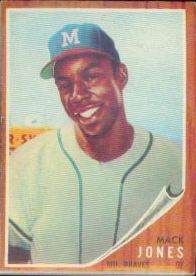 Mack
Jones Mack
Jones
#11 overall, Cleveland Barons
Jones broke
in with four hits in his first game, tying the post-1900 NL
mark. He hit 31 HR in his first full season (1965), finishing
third in the NL in home run percentage. He teamed that year with
Hank Aaron,
Eddie Mathews, Joe Torre, Felipe Alou, and
Gene Oliver as the Braves set a NL record with six 20-HR men
in one season. When the Braves moved to Jones's native Atlanta
in 1966 he hit 23 HR despite a shoulder injury, but his power
gradually dropped off until 1969. Playing for the expansion
Expos in cozy
Jarry Park, he hit 22 HR and batted a career-high .270, and
on April 14 he hit the first ML home run in Canada off
Nelson Briles.
(JFC)
|
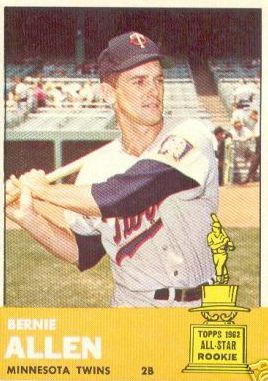 Bernie
Allen Bernie
Allen
#12 overall, Brooklyn Superbas
Allen, a
T-quarterback from Purdue, had his best major league season his
rookie year, with career highs in homers (12), RBI (64), and BA
(.269). After that, his bat faded, and he was mostly a part-time
defensive specialist. In five seasons with the Twins, he hit
.318 as a visitor in Washington, but batted just .193 in 1967
after his trade to the Senators.
(BC) |
|
