|
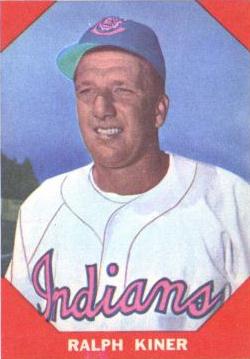 Kiner
Heads Free Agent Class Kiner
Heads Free Agent Class
by Doug Aiton
With
the start of the first UL Free Agency Auction, a quick rundown of
five who stand to make most as success-hungry UL GMs open their
checkbooks.
LF -
Ralph Kiner
Kiner is 36 and not getting any younger, and he only hit .232 with
15 homers last year. You think Ralph's going to go cheap?
Think again. A former MVP and 4-time all-star, there will be a
bundle of owners rushing to spend a fair chunk of change. The
reason? Anyone who walks 94 times in just 340 ABs and has had
an OPS above .900 for seven of the last nine seasons is undoubtedly
a premier hitter. Is Kiner aging? Yes. Is he done?
The smart money says no.
CF - Richie Ashburn
An excellent
defensive CF, the only thing that has blocked his path to All-Star
status these last three years has been Willie Mays. Well, that
and him being unable to hit the ball very hard. It can hardly
be argued that Ashburn doesn't make the most of his skills, however;
he'll scuffle 160 hits each year and steal 50 bases while turning
any ball into the wall into a triple. It seems like a
backhanded compliment to say 'good leadoff man' about one of the best
outfielders in the game today.
2B - Hank
Thompson
Thompson has spent all his career with the Monuments thus
far, and has a
trophy case packed with silverware to show for it. Three
all-star appearances, two Gold-Gloves and a host of championships
were accumulated in Washington, but economic necessity saw the
capital wave goodbye to one of its adopted heroes. It's
unfortunate for Hank that he put up his worst campaign since '55
last year, which precipitated his departure and probably will stop
him from earning even as much as he did from his last contract.
Interest will be high.
C - Roy
Campanella
Make no mistake --
Campanella is not the force he once was. He may have still hit
23 homers last year, but the days of him hitting .350 with 44
doubles are long gone. Yet Campanella deserves to be on this
list because of his achievements: five consecutive All-Star
selections behind the plate, an MVP campaign from that fabulous year
he split between St. Louis and Los Angeles, and memories of the
inaugural champion St. Louis side back in '51. Moreover, there
won't be a lack of interest in the aging star. Going into the
'60 season, most teams in the league (Detroit, LA, San Francisco)
are struggling to find half-way decent production behind the plate.
Word is that Campanella can be had for a reasonable price, but
you're only ever two interested parties away from a bidding war, and
the new free agency may give the aging superstar one last big
payday.
SP - Juan Pizarro
By all rights,
Pizarro should be nowhere near this list. The 22-year old
Puerto Rican, the fifth overall pick back in '57 by San Francisco,
pitched five games in '58 and had the dishonor of losing each start,
going 0-5 with a 6.53 ERA. However, Pizarro makes the list for
2 reasons: 1) we need a pitcher on here, and 2) over the
course of the year, Pizarro put together 14 good starts, coming up
with a 3.92 ERA and showing at least some ability to get outs.
It's got far more to do with the dearth of pitching talent than any
particular skills of his, but Pizarro will probably attract a
reasonable offer or two, and will certainly walk away with a seven-figure
multi-year sum - something that would have been pretty much
unthinkable at the start of the season.
Wall
Street Thinks Brooklyn
Is Just Superba!
 by Sean
Holloway by Sean
Holloway
In what
should come as no surprise to those who follow the UL, the Brooklyn
Superbas topped the list of most valuable teams as of the end of the
1959 season, estimated by a leading Street financial expert to be
worth a cool $95 million. The Detroit Griffins were hot on the
Superbas’ tails, coming in at $92 million, while the St. Louis
Maroons grabbed the third spot with a valuation of a little more
than $73 million.
At the UL-sponsored press conference where the valuations were made
public, this reporter managed to track down the senior business
analyst, a Mr. S. Michael Holloway, from the firm that conducted the
analysis, Dewey, Cheatham & Howe Ltd. According to
Holloway, the following metrics were used to determine the teams’
worth: current fan interest, team reputation, city (market)
size, cash on hand, and property, plants, and equipment (PPE).
Ok, so we don’t have any plants, but just go with it – all the
money my wife spent on my MBA degree has to be used some way.
After settling on these metrics, the valuation was started by
determining how much it would cost for each team to build the exact
same stadium it plays in at present. This “cost to
rebuild” figure was then multiplied by 20% on the assumption that
this is how much it would cost for a new owner to buy the land to
build a new stadium from scratch in the same town. A UL
franchise fee of $42,279,400 and cash on hand were then added to
generate a Cash, PPE, and Franchise Fee valuation number. Note:
for those interested, the MLB franchise fee for a team in 1998 was
$130 million, and the above figure for UL was achieved by simply
converting the 1998 figure of $130 million back into 1960 dollars at
a 3% inflation rate.
Once this number was generated, the bonus or penalty effects of
current fan interest, team reputation, and city (market) size were
then factored into the equation. For example, a high team
reputation figure between one and three earns the team an additional
bonus of 25% of the total Cash, PPE and Franchise Fee valuation
number, as this is a team that has historically been at the top of
the League and thus earns more – or more importantly – has the
potential to earn more than other teams as the popularity of
baseball increases across the US and the world.
St. Louis
, having the highest team reputation level, also earned an extra 5%
bonus for the team’s consistent and outstanding performance.
Conversely, a team with a reputation level of 8-10 would have been
hit with a 25% penalty to its value meant to reflect the team’s
poor earning potential and money a new owner would have to pour into
the team immediately to save a sinking ship. Current fan
interest levels were determined similarly, and city (market) size
corrections were made with large markets receiving bonuses and
smaller markets receiving penalties. Cash is also king and is
assumed to be a huge asset and competitive advantage since any new
owner would have to fork over a lot of money just to enter the
league and likely have little money left over for payroll, free
agents, stadium maintenance, marketing, etc. Thus, those teams
with lots of cash have an inherent higher value than those with
little or no cash.
Example: The Brooklyn Superbas have $2,839,373 cash on hand
and play in a 40,000 seat stadium. The current fan interest is
83, the team reputation is 3.0, and the city (market) size level is
10.
Cost to rebuild a 40,000 seat stadium: $60,000,000
Cost to purchase land in
Brooklyn
: 20% of $60,000,000 or $12,000,000
UL Franchise Fee: $42,279,400
Total Cash, PPE and Franchise Fee: $57,118,773
Brooklyn
also receives a bonus of 17% of this figure for its current fan
interest level, 25% for its team reputation level, and 25% for its
city (market) size level. Multiplying $57,118,773 by 1.67 will
take all these bonuses into account and result in a final valuation
of $95,388,351.
Mr.
Holloway was asked just how precise these figures were and responded
that they were “absolutely the dandiest numbers” he’d ever
come up with before mumbling “I’m so drunk” and heading off to
the bar. This reporter noticed an uncanny resemblance to
Detroit Griffins manager Sean M. Holloway, which leads him to
believe that there may be some connection or conflict of interest
somewhere. That, however, will have to wait for a later and
more hard-hitting investigative piece.
Before stumbling away, S. Michael Holloway did manage to state that
he did the best he could modeling all the factors that may account
for a team’s value, he assumes responsibility for any and all
mistakes made, that the whole process was made all the more
difficult due to the fact he did not have all the data necessary
(since much simply isn’t tracked by OOTP) and that he hoped people
would just get a kick out of this. With that comment this
reporter wholeheartedly concurs. Who cares what your team is
worth if you’re manhandling the others and winning the UL World
Series?
Going #1, A
Wicked-Pisser or a Shot in the Dark
A who’s-who and
where-are-they-now look at the #1 picks of past UL drafts
by
Lance Mueller
March
1, 1960
-- As the 1960 season approaches, we wave goodbye to a longstanding
UL tradition, the Reentry Draft. So, what better time to take
a look back at the players picked ahead of all of their peers over
the past nine United League seasons.
 1951 1951
Initial Draft
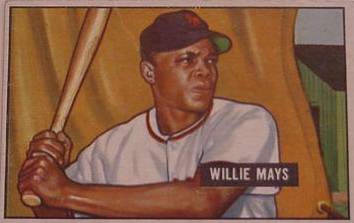
Willie Mays (WAS) – Stalwart centerfielder is
Washington
’s franchise player (twice named). 4 Gold Gloves, 5 time All-Star,
1958 MVP, top ten in almost all career offensive categories and
still 27 years young.
1952
Reentry Draft
Curt Simmons
(BRO) – Korean War returnee spent the first four years of his
career with the 'Bas before being traded to
L.A.
in 1956, the same year he won a career high 18 games. Released by
L.A.
in ’57, selected #2 overall in the reentry draft by
Boston
. Traded to NY in mid-1958 in a deal that brought Billy O’Dell to
Boston
.
Rookie Draft
Eddie Mathews
(LOU) – Third sacker spend a whole half a season with the Colonels
before being traded for pitchers Mike Garcia and Vinegar Bend Mizell
and Boston’s ’53 1st round reentry pick (LOU selected OF Dick
Kokos). Three time All-Star, 1 Gold Glove, and a cornerstone of
Charlie Qualls’ Cleveland Barons.
1953
Reentry Draft
Whitey Ford (CHI) – Another Korean War returnee, Ford gave the
Colts hopes of a Championship with his stellar stuff but broke many
a heart by spending large chunks of four seasons on the DL. The 1955
All-Star finally wore out his welcome in the
Windy
City
and was traded to
Brooklyn
in 1959 in perhaps the biggest blockbuster deal in UL history.
Rookie Draft
Ernie Banks
(CHI) – Slick fielding shortstop/first baseman became an immediate
fan favorite and was quickly dubbed “Mr. Colt”. Has cracked 30+
dingers and driven in 100+ runs in each of the past four
seasons. Two-time All-Star and one-time Gold Glove, Banks
looks to be in Colts blue and red for a very long time.
1954
Reentry Draft
Sid Gordon (LOU) – After three years in
Washington
, Sid was signed by the Colonels for just over two million dollars a
year. Had two solid years in
Louisville
(.314-21-108 in ’55) before retiring at the age of 37.
Rookie Draft
Hank Aaron (LOU) – Clearly the cream of the 1954 rookie crop, the
“Hammer” quickly developed into one of the most feared sluggers
in the UL. Has only one All-Star nomination (due to the dominance of
Ralph Kiner in left field) but has nabbed three Gold Gloves and
looks to be one of the keys to
Louisville
’s future.
1955
Expansion Draft
Ray Herbert (
L.A.
) – Plucked from
Louisville
, Ray has had only one winning season for the Outlaws (16-14 in
’56) and was relegated to reliever work during the final year of a
three-year contract
Ron Kline (S.F.)
– Snagged out of the Colonels' minor league system, Ron spent
another four years in the minors before being called up by the
Spiders for the ’59 season. Showed signs of strong potential with
14 wins to 15 loses in his first full year in the bigs. GM John
Nellis is looking for Kline to be a solid performer as much of his
starting staff approaches retirement age.
Reentry Draft
Vic Wertz (S.F.) – Power hitting first baseman spent four seasons
as a Gotham before being swooped in the ’55 Reentry draft (some of
us are still wondering what the hell he was doing there in the first
place). Had three solid years for the Spiders before falling out of
favor after a poor ’58 campaign. Signed to a minor league deal by
the Maroons, but in 1960 became first veteran to break from a minor
league servitude to become a free agent, under the league's new free
agent rules.
Rookie Draft
Roberto Clemente (
L.A.
) – Showed great potential in ’55 and ’56 before a serious
injury midway through the 1957 cost him the better part of two
seasons. Traded to N.Y. in July of 1958 in the deal that brought
Bubba
Church
to L.A. Shone in his first year for the Gothams.
1956
Reentry Draft
Bob Porterfield (BRO via a trade w/ DET) – Looked good in his
first year with the ‘Bas (17-11) but a poor start to the ’57
season had him going to Louisville for the Colonels ’58 3rd round
rookie pick (BRO got OF Carroll Hardy w/ the pick). Called back up
to the majors in the middle of the ’58 season, Bob went on to
stymie his old mates on his way to winning the World Series MVP.
Snatched up by the Spiders in the ’59 reentry draft, Bob went won
21 games and once again help his new team defeat the Superbas in the
World Series.
Rookie Draft
Frank Robinson (
L.A.
) – The heavy hitting outfielder is the only #1 UL rookie pick to
win Rookie of the Year. Has been arguably the Outlaws best players
and is a two-time All-Star (once in left, once in right). Part of
the best young trio of outfielders in the UL: Robinson, Pearson,
Pinson.
1957
Reentry Draft
Gil Coan (BOS) – A member of the Maroons’ initial draft squad,
the speedy outfielder spent six solid years in
St. Louis
. Had another two strong years with Boston/Cleveland before his age
began to show and GM Qualls severely cut back his on his playing
time.
Rookie Draft
Sandy Koufax (DET) – Leftie fireballer racked up 26 saves in each
of his first two seasons with the Griffs. Ill-fated turn as a
starter at the beginning of the ’59 season got him relegated to
bullpen work for the remainder of the year.
1958
Reentry Draft
Johnny Kucks (CHI via trade w/ L.A.) – Showed signs of the deadly
“P” (potential) in two years with the Outlaws and was
serviceable in his first year as a Colt (12-13). A poor start in
1959 got him shipped to
Brooklyn
in the Ford/Mantle for Ashburn/Mossi/Gorman blockbuster. Served up
1959 World Series ending walk-off homerun to the Spiders’ Jim
Lemon.
Rookie Draft
Albie Pearson (L.A.) – Picked ahead of the highly coveted Orlando
Cepeda (who went on to win the Rookie of the Year Award), Pearson is
a speedy, rangy outfielder who has yet to live up to his #1
selection but has the skills to spend many years playing alongside
Pinson and Robinson.
1959
Reentry Draft
Jim Busby (S.F.) – The longtime
Gotham
has always been a quiet killer, hitting for average with gap power
and stealing bases with very little fanfare. His presence in the
outfield was one of the keys to the Spiders’ Cinderella story that
ended with a World Series victory.
Rookie Draft
Harmon Killebrew (S.F.) – The brawny, barrel-chested “Killer”
had trouble making contact his first year in the league, but when he
did the ball was more often than not leaving deep dents in the cheap
seats. Look for Harmon to take aim at the homerun record real soon.
1960
Rookie Draft (Prediction)
Willie McCovey (WAS) – Power hitting first baseman will help take
a bit of the sting off as GM Doug Aiton is forced to cut loose a
number of key players due to salary troubles. Look for “Stretch”
to make an immediate impact and help get the Monuments headed in the
right direction.
 Reed's
Read Reed's
Read
Commentary by
Glen Reed
Dateline: San Francisco
arachnid gm
johnathan nellis is believed to be despondent over this latest run of
off-season events, which has turned bitter disappointment around the
unexpected hole in the san francisco infield, and i'm not talking
about the kind you step in. first, nellis put all his chips into an
effort to sign hammerin' hank thompson, regarded as an equal partner
in the best DP combo in UL history. to save up his pennies and make
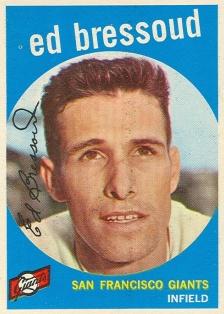
room for thompson, nellis exposed 1959 world series winning SS
eddie "i don't like your organization" bressoud to free
agency.
as an aside, this author
targeted bressoud heavily in free agency, planning to move reigning
MVP granny hammer from short to his natural position at second and
create the new, new best DP combo in UL history, backed by
swift-fielding glove man louis aparicio in a pretty sweet three-head
middle IF monster. but eddy turned out to be quite a wanker, refusing
to even hear my offer. instead, bressoud inked a long-term deal with
crosstown rivals gothams. b-sturd!!!!!
anyway, back to
nellis, who was still in the running for arguably the best
second-sacker in league history in thompson at this point in our
story. certainly, carrasquel-to-thompson-to-killer has a certain
ring to it. but in the event, the much-coveted hanky t inked with
skyrocketing division rivals Colts, breaking free of the spiders'
web. did i mention the best DP combo in UL history? well, move over
gil, here comes ernie.
to this point, nellis has got to be disappointed, but he's still in
possession of a brilliant fall-back plan--the powerful and rangy
ron hansen sitting in the rookie draft pool. but little could the SF
GM have known the plans of one crafty scottsman, eager to play
spoiler. washington gm douglas aiton also had his eye on hansen, and
the ability to move up in the draft to get him. to wit, aiton
essentially swapped gil mcdougald--the other half of the best DP combo
in league history--for hansen, saving about 10 years and $7MM in the
process.
that screeching sound you heard was nellis' primal scream upon
reading the latest draft update, seeing that yet another SS option had
escaped his clutches. nellis may well be forced to turn to the trade
market, as the remaining FA and rookie options look less than fitting
for the current holders of the Kaplan Cup. but not all's bad in SF--nellis
used the money he'd earmarked for his infield to re-acquire lefty
pitching prospect juan pizzaro, the subject of a bidding war of sorts
on the free agent market. and he plugged one of the few holes he'd had
from last year's squad by signing bill "backstop" sarni away
from chicago.
speaking of chicago, nellis has to be eyeing the baseball denizens of
the windy city with some concern. if nellis is to repeat as division
champion (he'd be the first--there've been three different west
champions in three seasons of divisional play), he'll have to claw his
way past the colts, who've revamped their starting rotation in the
last six months or so to include two cy young winners and a WS MVP.
throw in two of the starting eight from washington's heyday (thompson
and adcock), and we have a winner, as the carnies say. no matter how
you slice it, those moves certainly make chicago favorites to take
their turn atop the division and clock brooklyn in the series.
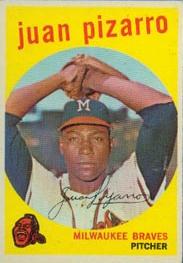 26
Million To Juan? 26
Million To Juan?
by Charlie
Qualls
They seemed like
pretty good odds at the time. A solid prospect with a solid year
under his belt, complete with World Series hardware. The
pitching hungry Cleveland Barons figured 2 Mil would be the first
round going rate for the most promising arm in the FA pile - so they
doubled it, tacked on another 1.2 Mil, a five year guarantee, a blow
job and a green card (just to be safe). But in Pizarro World,
money’s just not enough to get the deal done. Cleveland was
even prepared to sign a “no puns or ethnic jokes” clause, if
that’s what it took to land the 23 year old Puerto Rico native.
(The header for this article could have easily read “Picking Sour
Grapes.”) But if a guy doesn’t fancy your organization, what can
be done? Or maybe it’s the old Marxist adage (Groucho, not
Karl) about not wanting to be part of an organization that’s willing
to fork over $5.2 Million a year just to have you as a member.
The highly sought after Pizarro finally decided on a team, opting to
take his chances with a proven winner: his old team, the UL
champion San Francisco Spiders. And his bank account will be no
worse for wear, as he inked a 3 year, $4.75 Million deal.
|