
|
|||||||||||||||||||||||||||||||||||||||||||||||||||||||||||||||||
|
TRADES |
|||||||||||||||||||||||||||||||||||||||||||||||||||||||||||||||||
|
|||||||||||||||||||||||||||||||||||||||||||||||||||||||||||||||||
|
FREE AGENT SIGNINGS |
|||||||||||||||||||||||||||||||||||||||||||||||||||||||||||||||||
|
|||||||||||||||||||||||||||||||||||||||||||||||||||||||||||||||||
|
INJURED LIST |
|||||||||||||||||||||||||||||||||||||||||||||||||||||||||||||||||
|
|||||||||||||||||||||||||||||||||||||||||||||||||||||||||||||||||
|
"TOTAL UL" SABERMETRICS |
|||||||||||||||||||||||||||||||||||||||||||||||||||||||||||||||||
|
|||||||||||||||||||||||||||||||||||||||||||||||||||||||||||||||||
United
League of
American Base Ball Clubs
est.
1951
LEAGUE
FILE (7/31) ·
HEADLINES
· NEWS
LOG · TRANSACTIONS ·
INJURIES ·
FINANCES
STANDINGS ·
BOX
SCORES · SCHEDULE ·
BATTING ·
PITCHING ·
FIELDING · LEADERS
LEAGUE
RULES · TEAM INFO ·
ROSTERS ·
FREE
AGENTS · TOP
PROSPECTS · TOP
FARMS
TOP
PERFORMANCES ·
RECORD
BOOK · PAST
LEADERS · CAREER
LEADERS
BEGINNINGS ·
CITIES ·
BALLPARKS ·
PLAYER PHOTOS (1958)
·
OOTP 6.1 PATCH
TOTAL UL
· 1951 ·
1952 · 1953 ·
1954 ·
1955 ·
1956
·
1957
·
1958 Draft
3/8
· 4/7
· 4/17 · 5/1 · 5/16 · 6/1 · 6/16
|
|
Mantle Sent to Chicago
Major Shakeup in
Boston, "Gotta Compete with Brooklyn"
 Drysdale,
Hodges to Beacons
Drysdale,
Hodges to Beacons
BOSTON (June 16) --
Boston GM Charles B. Qualls was the eye of the storm in a whirlwind of
late spring trading today. In their last season in Beantown, and just five
games out of first place, Qualls is pulling out all the stops in an effort
to "steal a pennant before skipping town."
First, Boston dealt pitchers Curt Simmons and Arnie
Portocarrero, and two draft picks for New York's star pitching prospect
Billy O'Dell. O'Dell, 26, who is currently on the DL with a strained
back muscle, was the Gothams' #1 pick in 1957, but struggled in Triple-A
last year (0-5, 8.16 in six starts), and has fared only marginally better
in 12 starts with the big club this year (3-8, 5.33).
But the more dramatic trade saw the Beacons' first ever draft
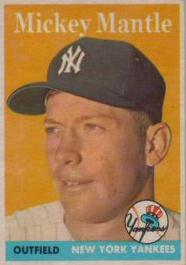
pick, outfielding phenom Mickey Mantle, shipped to Chicago for a package
of high-priced under-performers. Not that the Mick wasn't slumpin'. After an MVP at the age of 20 in 1953 and a strong
1955, Mantle has struggled. Since the beginning of last season, the
'Commerce Comet' is hitting just .237. And though his power has
rebounded a bit this year (.463 SLG compared to .424 last year), his
numbers are still far short of his peak seasons (.572 in 1953, .555 in
1955).
Drysdale was the Colts' #1 draft pick in 1956. Now 21,
he went straight the majors at age 19, and has yet to play a single
game in the minors. He won 13 games with a 4.04 ERA in his rookie
year, but suffered a sophomore slump last year (12-15, 4.68), and is even
worse so far this year (3-5, 5.70). First baseman Gil Hodges, part
of the putz-for-putz Hodges-Berra trade, turned back a three-year decline
last year, batting .251 with 34 HR, 84 RBI, and an .836 OPS (his best
since 1954). But in 47 games this year, the 33-year-old Hodges has
hit a new low, batting .165 with just 18 RBIs and a .599 OPS.
One of the key players in the trade, for Boston, was
centerfielder Jim Landis. Though Landis lacks the star power of the
hard-drinking, hard-playing Mantle, he brings a full toolbox to
Boston. Landis was Chicago's first round pick last year, and has the
potential to be a Gold Glove, and one of the league's top leadoff hitters.
In addition to Mantle, who becomes Chicago's franchise player
through 1964, the Colts acquired lefty pitcher Harvey Haddix (8-5, 3.51 in
14 starts and fresh off his first Player of the Week 6/9).
"Kitten", 33, is in his seventh year, his fifth as a full-time
starter, having compiled a 67-80 record and 4.28 ERA in 186 starts.
Though fairly consistent, Haddix has yet to have a breakout year. He
does fit the role of a bottom-of-the-rotation workhorse, and his 3.51 ERA
is a career-best pace. The third player in the package is second
baseman Jerry Priddy, who, at age 37, nursing a broken foot, and in the
final year of a $1.75 million contract, can only be considered a throwaway
or payroll equalizer.
On net, Chicago seems to have come out ahead in the
deal. After all, despite their recent slumpy trends, Hodges' more
resembles a long-term decline than Mantle's, since Mantle, 25, is eight years
younger. And as the pitchers go, performance-wise, Drysdale and
Haddix are equivalent: both have proven themselves to be nothing more than bottom-of-rotation
pitchers, at least so far. The
difference is that despite two-plus years of big league experience,
Drysdale, 21, is still a top prospect. Among pitchers 22 and under,
only Sandy Koufax matches Drysdale potential. But then again, only
Frank Robinson and Hank Aaron match Mantle's potential, in terms of the
combination of power, discipline, and hitting for average. So it's
probably fair to call the deal a push, or a 'change of scenery' trade,
since both Drysdale and Mantle were falling far short of their potential,
and both Mueller and Qualls are hoping against hope that their new digs
will spark a career revival.
 Streakers
in San Francisco
Streakers
in San Francisco
Itsy Bitsy Spiders
Climb Up the West Division
SAN FRANCISCO (June
16) -- An offensive outburst keyed a 9-4 fortnight, as San Francisco
pulled within a game of first in the volatile, if mediocre, West
Division. Four hitters have hitting streaks of six or more games,
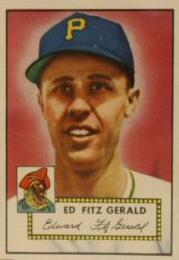
led by Ed Fitz Gerald's 13-game streak, three shy of his -- and the
franchise's -- record. Ken Boyer and Chico Carrasquel extended
career-best hitting streaks, and Rocky Colavito hit safely in six games,
and won Player of the Week for June 16. Colavito ranks sixth in home
runs and RBIs, and hit .500 (10-20) for the week, including five doubles
and six RBIs.
Fitz Gerald's 13-game hitting streak began on May 29, and the
33-year-old catcher is hitting .458 (22-48) during the streak. Seven
Spider regulars are averaging better than a hit per game in June, lead by
Fitz Gerald's .463, Boyer's .442, and Schoendienst's (part-time)
.429. The team as a whole is hitting .304 in June, after hitting
just .251 in the first two months (8th in the league). The Spiders
swept St. Louis to surge into second place. The highlight was a 7-0
five-hit shutout, anchored by Herb Score (6-7, 4.15). Colavito
homered with two doubles to lead the Spiders attack. 'Toothpick Sam'
Jones got his fourth win in a row, allowing just six hits in 8.1 innings
in a 5-4 win in Sunday's finale.
 McDermott's
Louisville Odyssey Ends
McDermott's
Louisville Odyssey Ends
'McSucks' Sent
McPacking
by Mark Allen
LOUISVILLE (June 1)
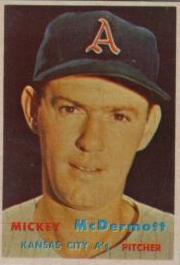
-- The long, sad saga
that revolved around former Colonels franchise player (a decision they
have ever since regretted) came to an end today. The Washington
Monuments, who need to fill the hole left by Don Larsen's injury, agreed
to send third baseman Don Zimmer to Louisville and they receive the
beleaguered McDermott in return.
Team owner
Mark Allen was quoted as saying, "We gave Mickey every chance.
We ran out of patience with him. He just doesn't seem to have the
desire or the motivation to use his God given talents. It's
ridiculous for one player to be responsible for half of his teams losses.
We'd be blowing the division away with even a decent pitcher. We
will be taking a gamble and move Mike Garcia into Mickey's starting role.
He will have to perform right off the bat because I will not hesitate to
replace him. The World Series means too much. We've
got a ton of decent pitching in AAA and with the way some of the guys (Porterfield
and Mizell) are pitching they could soon find themselves in Pittsburgh.
I will not hesitate to establish a Louisville to Pittsburgh shuffle until
I can find someone who can/will perform."
McDermott,
for his part, seemed happy to be going to Washington, which will get him
closer to his family in Poughkeepsie. "I just never fit in at
Louisville. First there was the pressure of being a #1 pick, then
being named franchise player. Add to that the lack of confidence
Mark has expressed from midway through my first season and the humiliation
I suffered taking a 90% pay cut. I may not be the brightest person
to ever play this game but I am smart enough to know when I am not wanted.
Besides that, I never
fit in with the rest of the team. All they ever want to do is play
cards, chase women and drink. I am a tee-totalling, regular church
going Pentecostal and they always held that against me. I hope my
replacement stinks and that the Colonels finish last."
Dissenting
Voice
Brooklyn GM Glen Reed on Mickey McDermott: "I don't know what you're
talkin' about, bro -- he may be oh-fer the rest of the league,
but he pitches like Cy Young whenever he comes to Brooklyn! I may
have to trade for him just to save myself the humiliation of being the
personal punching bag of this pitching potzer!"
 Take
Me Home, Dusty Rhodes
Take
Me Home, Dusty Rhodes
Griffin Leads
Batting Race
DETROIT (June 16)
-- The last Detroit player to win a batting title was George Kell with the
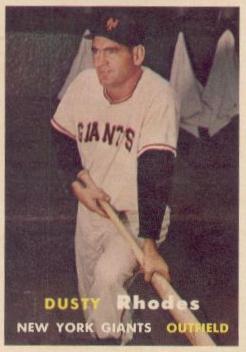
old AL Tigers in 1949. But 31-year-old outfielder Dusty Rhodes
(.379-8-34) is making a bid to become the first Detroit batting champ in
the Sound/Griffins era. Rhodes, a career .257 hitter through 1956,
is in the midst of the best batting seasons of his life. Last year,
the Mathew, Alabama native hit .330 in 132 games, but fell 58 plate
appearances from qualifying -- (he would have ranked fifth behind
Brooklyn's fab four Hit Men). This year, Rhodes got out of the gate
quickly, hitting .349 in April as a part-timer and .361 in May as a
full-timer. Since June 1, however, Rhodes has gone nuts, batting
.471 (16-34) in 10 games, with a .765 slugging percentage and 1.303
OPS. Rhodes, who played right field last year, has switched to
center field, where he has played 46 errorless games.
The closest a Sound/Griffin has come to a UL batting title
was Joe DiMaggio in 1951. Joltin Joe hit .335 that inaugural year, a
distant second to Jackie Robinson (.371). The next nearest
contenders were Catfish Metkovich (third in 1953 and fourth in 1954) and
Ralph Kiner (fourth in 1956).


